

Osteopenia and Posture: Building Stronger Bones Naturally
This article is general information, not medical advice. Bone density and supplementation should be managed with your doctor, who can review your scans and bloodwork.
Quick answer: Osteopenia is lower-than-normal bone density — reduced, but not far enough to be classed as osteoporosis. It is a warning sign rather than a disease, and bone responds to load: in postmenopausal women with low bone mass, eight months of supervised strength and impact training raised spine bone density by 2.9% while the comparison group’s fell 1.2%. Exercise works alongside whatever your doctor recommends, and it is the part you can start yourself.

The moment your doctor said “osteopenia,” did time seem to stop? Did visions of a frail future flash before your eyes? Take a breath. Your bone density score doesn’t have to become your destiny.
The Diagnosis That Doesn’t Have to Define You
If you’re among the millions diagnosed with osteopenia, you may be wondering what you can do yourself — alongside anything your doctor recommends — to protect your bones. There is a lot, and most of it involves how you move.
Osteopenia isn’t a disease; it’s a warning. Whether you need medication depends on your overall fracture risk, not the T-score alone, and that is a conversation for your doctor. What you can start on now is the thing bone responds to most directly: load.
At Activ8 Posture, we see many clients whose scans put them in the osteopenic range. Our part is the mechanical one: how you stand and move, how strong you are, and how well you balance — the things that decide how load reaches your bones and how steady you are on your feet.
Your bones respond to more than calcium. They respond to what you ask of them.

Understanding Osteopenia: More Than Just “Pre-Osteoporosis”
Osteopenia means your bone density is lower than the average for a young adult, but not low enough to be classified as osteoporosis. On the DEXA scan T-score scale:
- Normal: -1.0 and above
- Osteopenia: -1.0 to -2.5
- Osteoporosis: -2.5 and below
But here’s what these numbers don’t tell you: bone density is just one measure of bone health. Bone quality, architecture, and the forces acting on your bones matter too.
Not everyone with osteopenia progresses to osteoporosis. Whether medication makes sense depends on your overall fracture risk — age, history and other risk factors — and your doctor can weigh that with you. Exercise belongs in the plan either way: clinical guidelines include it as part of managing bone health.
A useful second question is what your bones are being asked to do day to day. That part is in your hands.
How Posture and Strength Connect to Bone
Your bones are living tissue, constantly remodeling themselves based on the forces they experience. How you stand and move shapes where those forces go — and just as importantly, how strong and steady you are when you move.

A few examples of how position changes load:
- Forward head posture increases load on cervical vertebrae
- Rounded shoulders alter rib cage position, affecting spine loading
- Anterior pelvic tilt changes how force transmits through hips and spine
- Collapsed arches disrupt the entire kinetic chain upward
What these change is how you load, how you move and how confident you feel doing it. That matters, because bone builds where it is loaded, and more than 90% of hip fractures follow a fall.
Think of calcium and vitamin D as building materials and loading as the instruction to build. Bone needs both.
How Your Body Actually Builds Bone (And Why Posture Matters)

Wolff’s Law, discovered in the 19th century, states that bones adapt to mechanical stress. This isn’t just theory — it’s the principle behind why astronauts lose bone density in zero gravity and why tennis players have denser bones in their dominant arm.
For bones to strengthen, they need:
- Appropriate load – Not too much, not too little
- Proper direction – Forces aligned with natural bone architecture
- Progressive challenge – Gradually increasing demands
- Recovery time – Periods for remodeling
This is where posture work earns its place. Poor posture often comes with weaker, less-used muscles and a narrower range of movement, which can limit how much useful load you can apply safely. Improving position and strength first makes it possible to progress further.
Posture alignment therapy builds that foundation, so the loading that builds bone can follow.
Exercise and Medication Work Together
Bone medications and exercise do different jobs, and the strongest plans use both where they are needed.
Medications such as bisphosphonates slow bone breakdown and are proven to reduce fracture risk in people who need them. Calcium and vitamin D supply raw materials. Exercise adds what neither can: the mechanical signal that tells bone to build, plus the strength and balance that prevent falls.
Here is what the exercise side contributes:
Physical Loading to Stimulate Growth:
Proper Alignment for Effective Loading:
Muscular Function to Create Bone-Building Forces:
That is why we start with position and strength: improving poor posture and the strength around it is what makes progressive loading possible and safe.
The most effective approach is both at once. Your doctor manages fracture risk, including medication where it is warranted, and a progressive program builds the strength, balance and loading your bones respond to. Whatever treatment you and your doctor choose, exercise makes it a fuller plan.

Where Posture Alignment Therapy Fits
Posture alignment therapy works on the mechanical side: how you are aligned, what range you have and what your muscles can contribute. For bone health, that means building the position and strength that let you load safely, then progressing.
How We Build It:
1. Precise Alignment
Before adding load, we ensure forces transmit properly through your skeleton. This means addressing everything from foot position to head placement.
2. Progressive Loading
Once aligned, we introduce weight-bearing exercises that stimulate bone growth without overwhelming your system.
3. Functional Integration
We teach you to maintain alignment during daily activities, so the work carries into the rest of your day.
Success Stories That Inspire:
My name is Michael and I have been a client for five years. The entire experience has been life changing and curative of my bilateral sciatic pain that I have had for years. The therapists at the clinic are very skilled both at their ability to diagnose your pain issues as well as listening to you and answering your questions about your condition.
Activ8 Posture treats the WHOLE body as opposed to the part that hurts. It makes sense that everything in the body is connected and it is necessary to treat all muscle and bone issues within a person’s musculoskeletal system. The therapists will take pictures of your current posture and run you through a few simple poses. From there, they will design a set of exercises for you to begin your journey to more comfortable movement.
The most important thing to remember is that recovery takes time. Your current misalignments and dysfunctions have been developing over your entire life. Reducing them to the point that you stop feeling pain needs to be worked on over a long term basis. You should be doing your exercise menu at least once per day. The consistency will allow your muscles to change faster that doing the exercises sporadically.
Finally, the resolution of chronic pain is not a predictably improving process which can be frustrating. While your muscles are changing as you do your exercises, your pain levels may not be resolving as quickly or as predictably as you like. This is where you need to lean on your therapist for help. Let him or her know how you are feeling. It won’t be the first time they heard it.
— Michael G., Activ8 Posture client
Exercises to Start With
Before you start: If you have osteopenia or osteoporosis, check with your doctor before beginning any new exercise program — especially if you have had a fracture, a fall, or recent back pain. Move slowly and stay within a comfortable range. Avoid forceful forward bending or twisting of the spine unless your clinician has cleared it. Stop if you feel sharp pain, dizziness, or new pain in your back, and get it checked. These exercises are general information, not a substitute for an individual assessment.
1. Sitting Knee Pillow Squeezes
Sit on the front edge of a sturdy chair with your feet flat, hip-width apart and pointing straight ahead. Roll your hips forward so your lower back gently arches, and keep your shoulders relaxed. Place a pillow or foam block between your knees. Squeeze it gently and release, keeping the arch in your lower back throughout. Do 3 sets of 20.
- Wakes up the inner thigh and hip muscles that steady the pelvis
- Practices sitting tall with a supported lower back
2. Sitting Scapular Contractions
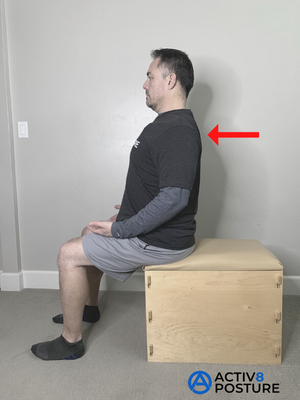
Sit on the front edge of a sturdy chair, feet flat and hip-width apart, with your hips rolled forward so your back is tall. Let your arms hang relaxed. Slowly draw your shoulder blades together as if holding a pencil between them, keeping your shoulders down and away from your ears. Hold for 2–3 seconds, then release. Repeat 10–20 times.
- Strengthens the upper-back muscles that counter a rounded upper back
- Builds the position that later strength work depends on
3. Sitting Hip Flexor Lifts
Sit on the front edge of a sturdy chair with your feet flat, hip-width apart and pointing straight ahead, hips rolled forward so your lower back gently arches. Keeping that arch and your trunk still, slowly lift one knee a few inches, hold for a moment, and lower it with control. Alternate sides. Do 3 sets of 10 on each side.
- Strengthens the hip flexors you use for every step and stair
- Builds the leg strength and control that support better balance
These seated exercises are a safe starting point. As your strength and position improve, the next step is progressive strength and impact work — the kind that raised spine bone density in the trials above — built up gradually and under guidance.
Key Principles for Bone Building:
- Prioritize alignment over intensity
- Progress gradually and consistently
- Include both impact and resistance exercises
- Allow adequate recovery between sessions
Creating Your Bone-Building Lifestyle
While posture alignment therapy provides the mechanical foundation, supporting lifestyle factors amplify your results:
Nutrition for Bone Health:
- Calcium: 1,000-1,200mg daily from food sources when possible
- Vitamin D: 600-800 IU daily (get levels tested)
- Protein: Essential for bone matrix formation
- Magnesium and other nutrients: worth reviewing with your doctor
- Check with your doctor or healthcare provider for specific supplement recommendations.
Daily Habits That Make a Difference:
- Morning posture check routine (2 minutes)
- Mindful sitting with proper support
- Regular standing breaks if sedentary
- Evening alignment exercises (10 minutes)
Recovery and Sleep:
- Stress management
- Quality sleep
- Appropriate exercise intensity (too much can harm)
Tracking Progress Without Obsession:
- Annual DEXA scans for objective data
- Monthly posture photos for visual progress
- Weekly strength/balance assessments
- Daily energy and confidence levels
Your Action Plan: From Diagnosis to Strength
Imagine this: one year from now, you’re reviewing your latest DEXA scan with your doctor, and you’re stronger, steadier and more confident than you were — with a plan you understand and can keep doing.
Getting there means working on what you can change — strength, balance, position and how you load — and addressing what makes movement uncomfortable so you can keep at it.
Your journey to stronger bones starts with understanding your unique postural patterns.
Frequently Asked Questions About Osteopenia and Natural Treatment
What is the difference between osteopenia and osteoporosis?
Osteopenia is characterized by bone density that’s lower than normal but not low enough to be classified as osteoporosis. On the T-score scale, osteopenia ranges from -1.0 to -2.5, while osteoporosis is -2.5 and below. Think of osteopenia as a warning sign that your bones are weakening. The good news is that bone still responds at this stage: the right exercise, good nutrition and attention to fall risk can help hold or improve bone density, alongside whatever your doctor recommends.
What are the best exercises for osteopenia?
The strongest evidence is for progressive resistance and impact training. In the LIFTMOR trial, women with low bone mass who did 30 minutes of supervised lifting and jumping twice a week for eight months gained 2.9% spine bone density while the comparison group lost 1.2%. Walking is great for general health but on its own does little for bone density, so add strength work and balance training. Technique and progression matter, which is why posture alignment therapy focuses on position and strength first, before the load goes up.
Can you reverse osteopenia naturally without medication?
Many people hold or improve their bone density with the right program, and exercise is the most powerful thing you can add yourself. Supervised strength and impact training has raised spine bone density by around 2–4% in trials of women with low bone mass. Good nutrition (especially calcium, vitamin D and protein) and addressing postural imbalances that limit how you move support it. Whether you also need medication depends on your overall fracture risk, which is your doctor’s call — and exercise helps whichever way that goes. For what changes if density falls further, see bone loss and posture; our posture alignment therapy exercises show where a program starts.
How does posture affect bone density in women with osteopenia?
Posture shapes how you load your skeleton and how steady you are on your feet. A rounded upper back is common as bone density falls, and it responds to training: in the LIFTMOR trial, upper-back rounding improved by 6.7° measured standing tall. Women are particularly susceptible to bone loss due to hormonal changes during menopause. Posture alignment therapy builds the position, strength and balance that make bone-loading exercise possible and lower the risk of falls. Joint and muscle aches often arrive in the same years; menopause joint pain covers what helps with those.
What supplements should I take for osteopenia, and are they enough?
Calcium (1,000–1,200 mg a day) and vitamin D (600–800 IU) support bone health, ideally from food first, with supplements as your doctor advises based on your levels. Supplements supply raw materials; loading supplies the signal to build. That is why good nutrition paired with posture alignment therapy and progressive exercise gives your bones the best chance.
Sources
- Watson SL, Weeks BK, Weis LJ, Harding AT, Horan SA, Beck BR. High-intensity resistance and impact training improves bone mineral density and physical function in postmenopausal women with osteopenia and osteoporosis: the LIFTMOR randomized controlled trial. J Bone Miner Res 2018;33(2):211–220. doi:10.1002/jbmr.3284
- Watson SL, Weeks BK, Weis LJ, et al. High-intensity exercise did not cause vertebral fractures and improves thoracic kyphosis in postmenopausal women with low to very low bone mass: the LIFTMOR trial. Osteoporos Int 2019;30(5):957–964. doi:10.1007/s00198-018-04829-z
- Kumar S, Smith C, Clifton-Bligh RJ, Beck BR, Girgis CM. Exercise for postmenopausal bone health – can we raise the bar? Curr Osteoporos Rep 2025;23:20. doi:10.1007/s11914-025-00912-7
- Sherrington C, Fairhall N, Kwok W, et al. Evidence on physical activity and falls prevention for people aged 65+ years: systematic review to inform the WHO guidelines on physical activity and sedentary behaviour. Int J Behav Nutr Phys Act 2020;17:144. doi:10.1186/s12966-020-01041-3
Related reading: Posture, Bones and Balance for Women Over 50: the complete guide.
Where to go next
- Browse Posture & Alignment for more on this topic.
- Read how we correct posture.
- Not sure where to start? A free 30-minute consultation and posture assessment, at one of our clinics or virtually, is the best first step.


