
Military Neck
Quick answer: Military neck is when the neck loses its natural inward curve and becomes unusually straight. It’s usually found on an X-ray, often alongside forward head posture. When the curve goes further and reverses into an outward bend, it’s called cervical kyphosis.
Maybe a chiropractor or doctor showed you an X-ray and said your neck has “lost its curve.” Maybe the phrase “military neck” sounded alarming, and you’ve been wondering what it means for you. It’s a very common finding, and understanding it takes a lot of the worry out of it.
What Is Military Neck?
Seen from the side, a healthy neck has a gentle inward curve, called cervical lordosis, that helps balance the weight of the head. With military neck, that curve is reduced so the neck bones stack in a straighter line. The name comes from the image of a soldier standing at attention, but military service has nothing to do with it; the term simply describes the shape.
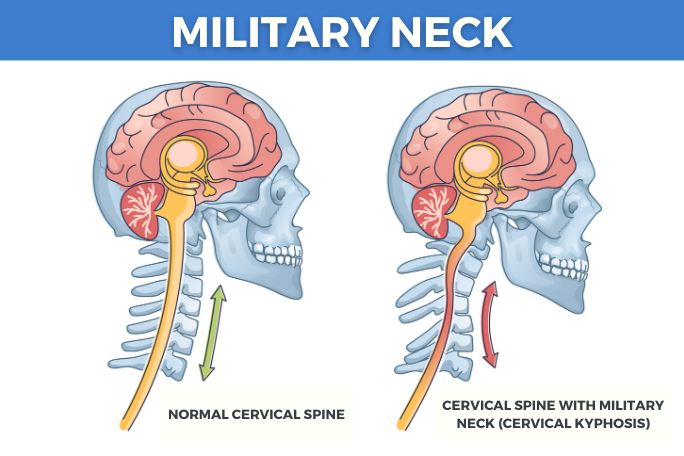
Military Neck vs. Cervical Kyphosis vs. Forward Head Posture
- Military neck: the neck’s inward curve is reduced or lost, so the neck is straight.
- Cervical kyphosis: the curve has reversed, so the neck bends forward.
- Forward head posture: the head sits ahead of the shoulders. It often travels with military neck, but it describes where the head sits rather than the shape of the neck itself.
The first two are confirmed with an X-ray. You can’t reliably tell from the outside whether your neck curve is straightened, because the head and upper back can look similar either way.

Is Military Neck Serious?
Usually not on its own. A straightened neck curve is a common X-ray finding, including in people with no neck pain. One study of adults over 45 found no difference in neck curvature between people with and without neck pain. So an X-ray finding of military neck isn’t, by itself, a reason for alarm, and it doesn’t automatically explain someone’s pain. What matters more is how your neck moves, how your head and upper back are positioned, and what symptoms you have.
What Causes Military Neck?
- Posture and habits. Long periods with the head forward over screens and desks (tech neck) can change how the neck holds its curve.
- The upper back and shoulders. How the upper back is positioned, whether rounded (hunchback) or held stiffly, changes what the neck has to do above it.
- Muscle spasm or guarding. After an injury such as whiplash, tight neck muscles can temporarily straighten the curve.
- Age-related disc changes. As the discs between the neck bones lose height, the curve can flatten.
- Congenital or structural causes. Less often, the neck bones formed differently from birth.
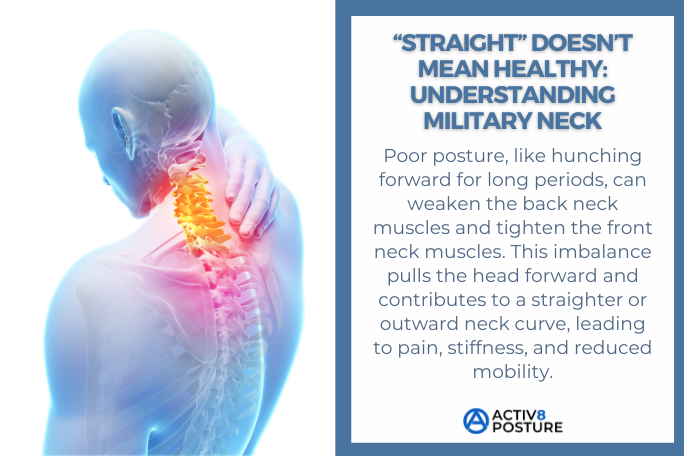
What Are the Symptoms of Military Neck?
Many people have no symptoms. When there are symptoms, people commonly describe:
- Neck stiffness and aching
- Headaches that start at the base of the skull
- Difficulty looking up, or reduced range when turning the head
- Tightness through the shoulders and upper back
See a doctor if you have numbness, tingling or weakness in your arms or hands, problems with balance or coordination, severe headaches, or neck pain after an injury.
How Do You Fix Military Neck?
Being told your neck “has no curve” can make it sound like something needs to be forced back into place. In practice, the neck’s curve depends on what’s beneath it: how the upper back, shoulders and pelvis are positioned, and how you use your head and neck through the day.
What tends to help is improving how the head and neck are supported: restoring movement in the upper back, bringing the head back over the shoulders, and changing screen and desk habits. How much the curve itself changes on an X-ray varies from person to person, and curves shaped by disc changes or structural causes behave differently. The goal is a neck that moves well and feels better, not a perfect X-ray.
Exercises and Habits
Because military neck so often travels with a forward head, the exercises in our forward head posture and tech neck guides are a good place to start. Raising your screens to eye level and bringing your phone up, rather than your head down, helps too.
Choosing Your Next Step
There’s no single right path. It depends on how you like to work:
- You’d like to start on your own. The exercises and habits in the linked guides are a sensible place to begin.
- You’d like someone to look at the whole picture. A free 30-minute consultation includes a postural assessment and a conversation about your history and any imaging you’ve had. We have clinics in Newton, Gloucester, Santa Monica, Beverly Grove and Middletown, RI.
- You’re not near a clinic. Virtual posture therapy brings the same assessment approach to you.
Frequently Asked Questions About Military Neck
Is military neck the same as cervical kyphosis?
Not quite. Military neck means the neck’s curve is straightened. Cervical kyphosis means it has reversed into a forward bend. They’re related, and sometimes used loosely for each other, but they describe different amounts of change. See cervical kyphosis.
Can military neck be corrected?
Many people with military neck improve how their neck feels and moves with work on posture and habits. Whether the curve on an X-ray changes, and by how much, varies, and depends on the cause. Curves shaped by disc changes or structural causes won’t change the same way.
How do I know if I have military neck?
Only an X-ray can show it for sure. A forward head, neck stiffness or difficulty looking up can all go along with it, but they don’t confirm it. If you’ve had neck imaging, your doctor can tell you whether the curve is reduced.
How common is military neck?
A straightened neck curve is a common finding on X-rays, including in people without neck pain. That’s one reason it’s best understood alongside your symptoms and posture rather than on its own.
This article is general education, not medical advice. If you have arm numbness, tingling or weakness, balance or coordination problems, severe headaches, or neck pain after an injury, see a physician first. Posture therapy works alongside medical care, never instead of it.
Where to go next
- Browse the Posture Dictionary for related terms.
- Not sure where to start? A free 30-minute consultation and posture assessment, at one of our clinics or virtually, is the best first step.