
Neck Hump
Quick answer: A neck hump is a rounded bump where the base of the neck meets the upper back. Most often it’s a postural pattern: the upper back rounds forward, the head drifts ahead of the shoulders, and the area where they meet takes the strain. Sometimes it has a medical cause, such as bone loss or a hormonal condition, which is why it’s worth knowing the difference.
Maybe you caught it in a side-on photo, or felt it running a hand down the back of your neck. Maybe it’s been there for years and has recently started to ache, or you’ve watched a parent develop one and wondered whether you’re heading the same way. Feeling self-conscious about it is common. Understanding what’s behind yours is the first step to knowing what you can do about it.
What Is a Neck Hump?
“Neck hump” isn’t a formal medical term. It’s the everyday name for a visible prominence at the base of the neck, where the lowest neck vertebrae meet the top of the upper back. When it’s postural, it reflects how the upper spine is carrying the head: the upper back rounds (kyphosis), the head moves forward to compensate, and the tissues at that junction take on extra load.

There is a measurable version of this. The upper back is supposed to curve — the American Academy of Orthopaedic Surgeons puts a normal thoracic curve at 20 to 45 degrees and calls a curve greater than 50 degrees abnormal. Published thresholds vary a little between sources, and some clinicians use 40 degrees. So a visible hump is not a curve that should not be there; it is more curve than that range, or a curve sitting lower and sharper than usual.
Is a Neck Hump the Same as a Dowager’s Hump?
Largely, yes. Several names get used for the same area, and they overlap:
- Dowager’s hump is an older name for a rounded upper back often seen in older women, and it’s frequently linked to bone loss. Despite the name, it can appear at any age, and we see it more and more in younger people who spend long hours on screens.
- Hunchback is the everyday word for an exaggerated rounding of the upper back, and kyphosis (or hyperkyphosis) is the medical term. See our entry on hunchback posture.
- Buffalo hump is different. It’s a pad of fat, not a curve in the spine. More on that below.
- Scheuermann’s kyphosis is a structural form that develops during adolescence, when some vertebrae grow wedge-shaped. It’s diagnosed by a doctor with an X-ray.
Is It a Neck Hump or a Buffalo Hump?
A buffalo hump (a dorsocervical fat pad) is a buildup of fatty tissue between the shoulders rather than a change in the curve of the spine. It can be linked to Cushing’s syndrome, long-term steroid medication, or other conditions that affect how the body stores fat. If your hump feels soft, appeared fairly quickly, or comes with other changes such as a rounder face, weight gain around the middle, or easy bruising, see a physician before starting any exercise program.
Telling the Three Apart
Three different things produce a bump in roughly the same place, and they are not treated the same way. This is the distinction worth making before you start doing anything about yours.
| Type | What it is | Clues that point to it | What helps |
|---|---|---|---|
| Postural rounding | The upper back is held in more forward curve than it needs; the head sits ahead of the shoulders | Changes with position — it softens when you stand tall or lie flat. Common in people who spend hours at screens. Any age | Movement and strengthening work, plus changing the daily setup |
| Structural change in the bone | The shape of the vertebrae themselves has altered, from compression fractures or from a growth condition such as Scheuermann’s | Does not soften when you lie flat or stand tall. Often with height loss. More likely over 50, especially after menopause | A doctor’s assessment first. Exercise still has a role, but it is not going to restore the bone’s shape |
| A fat pad (a “buffalo hump”) | A soft accumulation of fat at the base of the neck, not a change in spinal curve | Feels soft rather than bony. May come with weight changes, easy bruising, or starting a new medication | A medical workup — this one is endocrine, not mechanical |
The practical version: lie flat on your back on a firm surface, or stand as tall as you can, and see what happens to it. A postural hump reduces. A hump built into the bones does not. That single observation tells you which of the three conversations you need to have, and it takes ten seconds.
Why This Is More Common in Women
It is one of the most searched questions on this topic, and it has a real answer. Thoracic curve increases with age in everyone, but it increases faster in women, particularly through the menopause years. Hyperkyphosis — an upper-back curve past about 40 degrees, where 20 to 40 degrees is the normal range — is present in roughly 20 to 40 percent of adults over 60.
Bone is the reason. American Family Physician reports that four in ten white women older than 50 will experience a hip, spine or vertebral fracture in their lifetime, and that chronic vertebral fractures may show up as loss of height along with a rounding upper back. Vertebral fractures are found in at least 40 percent of people who have hyperkyphosis, and each one adds around 3.8 degrees to the curve. That is the mechanism by which bone loss becomes a visible hump.
And here is the part that matters most. More than two-thirds of vertebral compression fractures cause no symptoms at all — in the words of that review, patients “are asymptomatic, and are diagnosed incidentally.” So a hump that appeared without any back pain, or that has grown over a few years, is not reassuring just because nothing hurt. If you are over 50, or past menopause, or have lost height, the useful next step is asking your doctor about a bone density test — not a new exercise routine.
The old name for this, Dowager’s hump, was coined for exactly this population. The name is outdated and we would not use it about anyone, but it is a reminder that the postmenopausal version of this has been recognized for a very long time, and that it is a bone question before it is a posture question. If joint aches and stiffness have arrived with the transition too, menopause joint pain covers what helps.
What Causes a Hump on the Back of the Neck?
The most common causes are postural:
- Forward head posture. Hours looking down at phones and laptops pull the head ahead of the shoulders, and the base of the neck works overtime to hold it there. See forward head posture and tech neck.
- A rounded upper back and shoulders. A tight chest and an under-used upper back let the shoulders roll forward and the upper spine curve more. This pattern is often described as upper crossed syndrome, and it frequently comes with rounded shoulders.
- What’s happening below. The upper back doesn’t work alone. When the pelvis tucks under or the lower back sways forward (sway back), the upper back often rounds to keep you balanced. That’s why we look at the whole body, not just the neck.
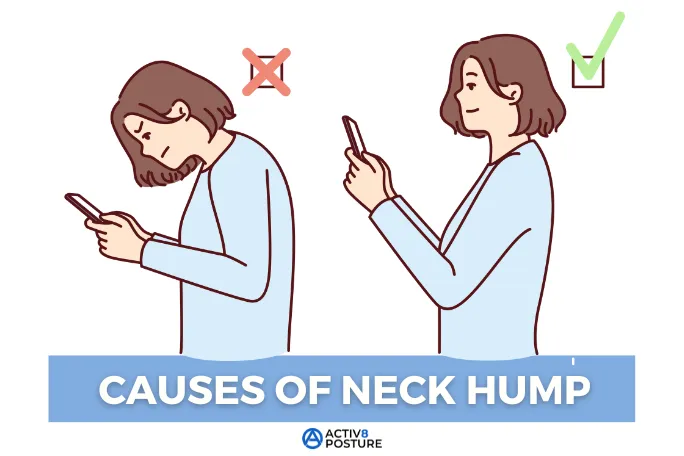
Some causes are medical, and they need a doctor’s input:
- Osteoporosis. Weakened vertebrae can develop small compression fractures, which can lead to a stooped or hunched posture. More than two-thirds of these fractures cause no symptoms and are found incidentally, so many people do not know they have them.
- Scheuermann’s kyphosis and other structural conditions that shape the spine during growth.
- Hormonal and fat-distribution conditions, which produce a buffalo hump rather than a postural one.
What Are the Symptoms of a Neck Hump?
Many people with a neck hump feel nothing; it’s something they see rather than feel. When it does come with symptoms, people commonly describe:
- Stiffness at the base of the neck, or an ache between the shoulder blades
- Tension headaches that seem to start at the back of the head
- Trouble looking up, or turning the head fully to one side
- Feeling self-conscious about how the neck and shoulders look in photos
If you notice numbness, tingling, or weakness in your arms or hands, see a doctor, as that can mean a nerve is involved. For more on neck discomfort and posture, see neck pain from poor posture.
How Do You Fix a Neck Hump?
If you’ve tried pulling your shoulders back or reminding yourself to “sit up straight,” you’ve probably noticed it lasts a few minutes. That’s not a willpower problem. The hump is the visible end of a whole-body pattern, so pressing on the spot where you see it rarely changes much.
When a neck hump is postural, what tends to help is changing the pattern that keeps the upper back rounded: restoring movement through the upper back and chest, strengthening the muscles between the shoulder blades, bringing the head back over the shoulders through the day, and addressing what the hips and pelvis are doing underneath. How much the hump changes varies from person to person. Humps with a structural or medical cause behave differently from postural ones.
There is reasonable evidence that this works, and it is worth being precise about how strong it is. A systematic review and meta-analysis in PLOS ONE pooled 10 randomized controlled trials — 284 people doing exercise programs against 255 controls — and found a large improvement in thoracic kyphosis angle (SMD −1.40, 95% CI −2.15 to −0.66). The authors’ conclusion about which exercise points the same way as the rest of this field: “strengthening rather than stretching could be more relevant for kyphosis.”
The caveat belongs here too. Three of those ten trials were rated low quality, and when they were excluded the improvement lost statistical significance in a sensitivity analysis, with high variation between studies throughout. So the honest summary is that exercise looks genuinely useful for a postural curve and the evidence is not yet settled. Anyone telling you a fixed number of degrees in a fixed number of weeks is going beyond what has been shown.
What exercise cannot do is reshape a vertebra. If compression fractures are part of your curve, strengthening the surrounding muscles can still help you hold yourself better and move more confidently, but the bone’s shape is not going to change. Medication for bone loss works the other way round: it reduces the risk of new fractures without correcting the curve that existing ones caused. The two jobs are separate, and someone with both needs both.
Strength work is safe and effective even when bone density is low. In one trial, postmenopausal women with low bone mass who did eight months of supervised strength and impact training improved their upper-back rounding by 6.7° measured standing tall, compared with 1.6° in the comparison group — with no new spinal fractures. If you have osteoporosis or have had a fracture, start with guidance and your doctor’s okay.
Exercises for Neck Hump (Dowager’s Hump)
These four gentle exercises are good starting points. If you have osteoporosis, a known spinal fracture, or pain that gets worse with movement, check with your doctor before trying them, and never force a position.
1. Wall Counter Stretch
Stand facing a wall, about two and a half to three feet away, with your feet hip-width apart and pointing straight ahead. Place your palms flat on the wall at shoulder height, fingers spread. Keeping your elbows straight, hinge at the hips and let your trunk lower toward horizontal, allowing your upper back to gently extend. Hold for 30 to 60 seconds. Don’t push lower than is comfortable, and stop if anything hurts.

2. Sitting Pull-Overs
Sit tall on the front edge of a sturdy chair. Lace your fingers together and, keeping your elbows straight, slowly raise your arms overhead as far as is comfortable, breathing in as you lift. Breathe out as you lower your hands back to your lap. Repeat 10 to 30 times.

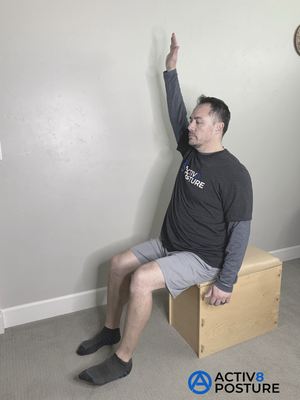
3. Sitting Cross-Crawling
Sit tall on the front edge of a chair. Raise one arm as high as is comfortable while lifting the opposite foot off the floor, then lower both together. Alternate sides for 10 to 20 repetitions, keeping the movement slow and your lower back gently arched.
4. Shoulder Blade Squeezes
Sit or stand tall. Draw your shoulder blades down and back, away from your ears, and squeeze them gently together. Release and repeat 15 to 30 times.
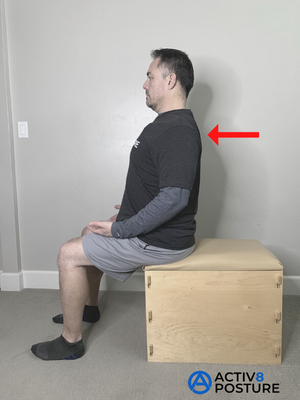
Exercises like these are a starting point, not a full program. The most useful routine for you depends on what’s driving your hump, which is exactly what an assessment looks for.
How Can I Keep a Neck Hump From Getting Worse?
- Raise your screens to eye level, and bring your phone up rather than your head down.
- Break up long stretches of sitting; even a minute of standing and moving every half hour helps.
- Sit with your weight on your sit bones and a gentle arch in your lower back, rather than slumping into the chair.
- If you’re over 50 or have risk factors for bone loss, ask your doctor whether a bone density test makes sense.

Choosing Your Next Step
There’s no single right path. It depends on how you like to work:
- You’d like to start on your own. The four exercises above and the everyday habits are a sensible place to begin.
- You’d like someone to find what’s driving it. A free 30-minute consultation includes a postural assessment and a conversation about your work, habits and history. We have clinics in Newton, Gloucester, Santa Monica, Beverly Grove and Middletown, RI.
- You’re not near a clinic. Virtual posture therapy brings the same assessment approach to you.
Frequently Asked Questions About Neck Hump
Can a neck hump go away on its own?
It rarely changes by itself if the habits behind it stay the same, because the body keeps adapting to how you use it. When a hump is postural, changing how you sit, move and use screens, along with targeted exercise, is usually what shifts it.
How long does it take to get rid of a neck hump?
There’s no honest single answer. It depends on the cause, how long the pattern has been in place, and how consistently the work gets done. A hump caused by bone changes or a fat pad won’t respond the same way as a postural one. An assessment is the best way to get a realistic picture for your situation.
Is a neck hump in the neck or the upper back?
Usually both. The visible bump sits where the lowest neck vertebrae meet the upper back, and most postural neck humps involve extra rounding in the upper back combined with the head sitting forward. A problem with the neck’s own curve, such as military neck, where the natural curve straightens, tends to look different.
When should I see a doctor about a neck hump?
See a physician if the hump appeared quickly or feels soft, if you’ve lost height, if you have back pain after a minor fall or strain, if you notice numbness or weakness in your arms, or if it comes with other changes in your body. Over time, several small vertebral fractures can produce a hump at the top of the spine, and these need medical care.
This article is general education, not medical advice. A neck hump can have medical causes. See a physician first if it appeared quickly, feels soft, or comes with pain, numbness, height loss or other changes in your body; they may refer you to an orthopedist or endocrinologist. Posture therapy works alongside medical care, never instead of it.
Related reading: Neck Hump, Forward Head and Upper Back Posture: the complete guide.
Where to go next
- Browse the Posture Dictionary for related terms.
- Not sure where to start? A free 30-minute consultation and posture assessment, at one of our clinics or virtually, is the best first step.
Sources
- González-Gálvez N, Gea-García GM, Marcos-Pardo PJ. Effects of exercise programs on kyphosis and lordosis angle: A systematic review and meta-analysis. PLOS ONE, 2019. Meta-analysis of 10 randomized controlled trials, 539 participants.
- McCarthy J, Davis A. Diagnosis and Management of Vertebral Compression Fractures. American Family Physician, 2016.
- Thoracic Hyperkyphosis. Physiopedia — clinical reference summarizing prevalence, measurement thresholds and treatment evidence.
- Osteoporosis. National Institute of Arthritis and Musculoskeletal and Skin Diseases.
- Cushing’s Syndrome. National Institute of Diabetes and Digestive and Kidney Diseases.
- Kyphosis (Roundback) of the Spine. OrthoInfo, American Academy of Orthopaedic Surgeons.
- Overview: Osteoporosis and bone fractures. InformedHealth.org, Institute for Quality and Efficiency in Health Care (IQWiG).
- Watson SL, Weeks BK, Weis LJ, et al. High-intensity exercise did not cause vertebral fractures and improves thoracic kyphosis in postmenopausal women with low to very low bone mass: the LIFTMOR trial. Osteoporos Int 2019;30(5):957–964. doi:10.1007/s00198-018-04829-z