
Hyperlordosis
Quick answer: Hyperlordosis is an exaggerated inward curve of the lower back, so the back arches more than usual and the belly and buttocks tend to push out. It often comes with the pelvis tipped forward. Everyone has some inward curve in the lower back; hyperlordosis is when that curve is larger than it needs to be, and most often it’s a posture pattern you can work on.
Maybe you’ve noticed a deep arch in your lower back in photos, or you can slide your whole forearm behind your back when you lie flat. Maybe your lower back feels tight after standing, and stretching only helps for a while. You might have heard it called lordosis, swayback or an arched back. Here’s what’s actually going on.
What Is Hyperlordosis?
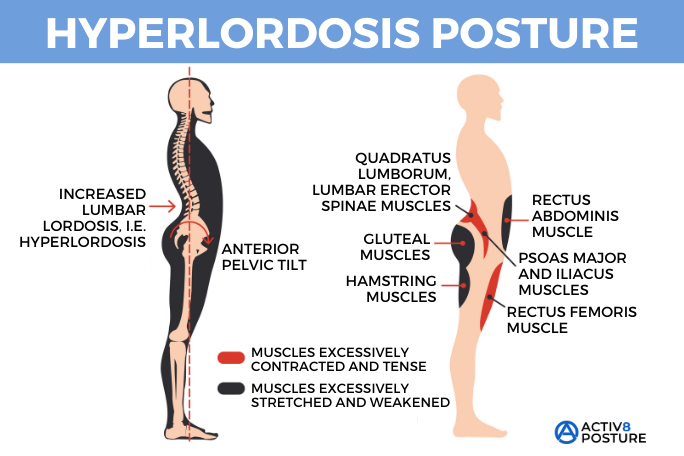
Your lower back naturally curves inward; that’s lumbar lordosis, and a small degree of it is normal. With hyperlordosis, the curve is exaggerated. From the side, the lower back arches more deeply, the pelvis usually tips forward (anterior pelvic tilt), and the belly and buttocks become more prominent.

Hyperlordosis vs. Lordosis vs. Sway Back
- Lordosis: the normal inward curve of the neck and lower back. People often say “lordosis” when they mean too much curve.
- Hyperlordosis: too much inward curve in the lower back.
- Sway back: the hips sit forward of the trunk while the upper body leans back. It can come with an exaggerated arch, but it can also occur with the pelvis tipped backward or level, so it isn’t the same thing.
- Flat back: the opposite, with too little curve in the lower back.
Do I Have Hyperlordosis?
- Wall test. Stand with your heels a few inches from a wall and your buttocks and shoulder blades touching it. Slide your hand behind your lower back. If your hand slides in easily with lots of room to spare, or your forearm fits, your curve may be increased.
- Floor test. Lie on your back on the floor with your legs straight. Is there a large gap under your lower back? Now bend your knees with your feet flat. Does the gap mostly close?
- Flexibility check. Bend forward slowly as if to touch your toes. If your lower back rounds out easily, the curve is flexible. If it stays arched, mention that to a doctor.
- Side-view photo. Do your belly and buttocks push out noticeably, with a deep arch between them?
A curve that flattens when you bend forward is usually postural. Medical guidance notes that a flexible curve often doesn’t need medical treatment, while a curve that stays fixed is worth having checked.
What Causes Hyperlordosis?
- How the pelvis sits. A forward-tipped pelvis increases the lower-back curve. Long hours sitting, and how the hip flexors, glutes and abdominal muscles share the work of holding the pelvis, all play a part. See anterior pelvic tilt tests.
- What’s happening above. A rounded upper back (hunchback) or head sitting forward can lead the lower back to arch more to keep you balanced.
- Standing and training habits. “Chest up, shoulders back” cues, high heels, and lots of arched-back training such as gymnastics or dance.
- Pregnancy. The growing belly shifts your center of gravity forward, and the lower back often arches more to compensate.
- Medical causes. Less often, a slipped vertebra (spondylolisthesis) or other spinal conditions.

What Are the Symptoms of Hyperlordosis?
Some people with a deep arch feel fine. When there are symptoms, people commonly describe:
- Lower back tightness or aching, often after standing or walking
- Discomfort lying flat on your back, which eases with your knees bent
- Tight hip flexors and hamstrings
- Core exercises that never quite seem to “switch on”
- A belly that pushes forward even without weight gain
None of these proves hyperlordosis is the cause. See a doctor if you have pain that travels down your leg, numbness, weakness, or changes in bladder or bowel control.
How Do You Fix Hyperlordosis?
If you’ve tried tucking your tailbone or bracing your abs to flatten your back, you’ve probably found it lasts only as long as you’re thinking about it. That’s because the arch is where your body has settled, balancing what the pelvis, hips and upper back are doing.
What tends to help is changing that balance: restoring how the pelvis sits, balancing the muscles around the hips and trunk, and addressing the upper back. How much the curve changes varies from person to person, and curves with a medical or structural cause behave differently. If core work never seems to connect, our rib flare guide explains how breathing and rib position play a part.
Exercises for Hyperlordosis
Five starting points. Move slowly and stop anything that causes pain.
1. Static Back
Lie on your back with your calves resting on a chair or couch, so your hips and knees are bent to about 90 degrees. Rest your arms out to the sides, palms up. Breathe slowly and let your back settle toward the floor. Stay for 5 to 10 minutes.

2. Airbench
Stand with your back against a wall and walk your feet forward until you can slide down into a sitting position, knees bent to about 90 degrees and heels under or slightly in front of your knees. Keep your feet and knees hip-width apart, pointing straight ahead, and let your lower back settle against the wall with your weight in your heels. Hold for 1 to 2 minutes, sitting higher on the wall if your knees feel strained.

3. Standing Windmill
Stand with your back to a wall, heels, hips and shoulders touching, feet hip-width apart and pointing straight ahead. Spread your arms out to the sides with the backs of your hands on the wall. Keeping your hips still, slowly bend your trunk to one side, return to center, then bend to the other side. Do 5 repetitions with feet hip-width apart, 5 slightly wider than your shoulders, 5 with feet 2 to 3 feet apart, then 5 more back at hip-width.

4. Cats and Dogs
Start on your hands and knees, wrists under your shoulders and knees under your hips. Let your back and shoulder blades drop gently toward the floor. Breathing out, round your spine from your tailbone up through your upper back, letting your head drop. When you run out of air, let your back sink back down as you breathe in. Repeat 10 times.

5. Plank
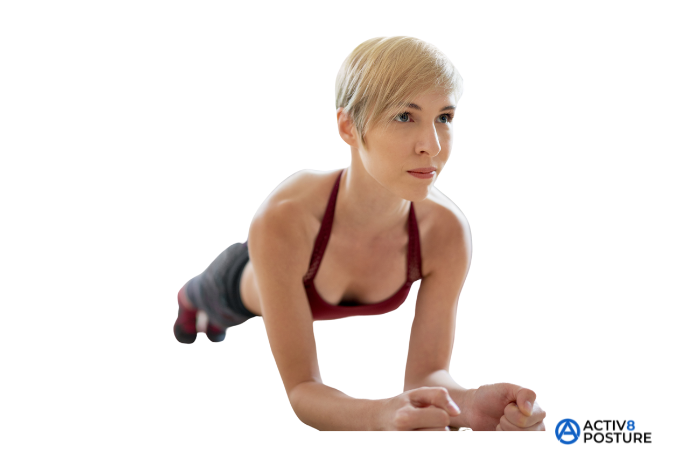
Lie face down, then prop yourself up on your forearms, elbows under your shoulders and forearms parallel. Tuck your toes under and lift your body so you’re balanced on your forearms and toes, in a straight line from head to heels. Don’t let your hips sag, which would deepen the arch. Breathe steadily and hold for 30 to 60 seconds.
Does a Flexible Curve Need Fixing?
There is a straightforward answer to this from a medical source, and it is more reassuring than most content on the topic. UF Health describes the test as whether the curve reverses when you bend forward: if it does, “it is generally not a concern.” Their summary of what to do about it is blunter still — “Most of the time, lordosis is not treated if the back is flexible. It is not likely to progress or cause problems.”
A curve that does not move when you bend forward is the one that warrants a medical assessment. That is the same logic the upper back follows, where the orthopedic distinction is whether a rounded thoracic curve straightens when you stand tall. Across both curves, flexible is the reassuring finding and fixed is the one to have looked at.
What the Research Actually Shows About a Big Arch
Four findings are worth having before you decide your lower back curves too much, because together they undercut the usual story.
First, back pain goes with less curve, not more. A systematic review and meta-analysis in The Spine Journal compared 796 people with low back pain against 927 controls across 13 studies and found the back-pain group had smaller lumbar curves (SMD −0.33, 95% CI −0.46 to −0.21 in age-matched studies). The effect is small and every study was cross-sectional, so it cannot establish cause — but it points the opposite way from the advice to flatten an exaggerated arch.
Second, the pelvic position that usually accompanies it is the norm. In 120 symptom-free adults, anterior pelvic tilt was found in 85 percent of men and 75 percent of women. Neutral was the minority.
Third, the normal range is enormous. Across 26 normative studies, lumbar lordosis described as normal spanned roughly 31 to 88 degrees, with measured averages around 44° (L1–L5) or 58° (L1–S1) depending on which vertebrae you measure between. Radiography and photogrammetry showed “no concordance” with each other.
Fourth, and most broadly: a study measuring eight postural angles in 99 healthy people concluded that the results suggest “a large between-subject variability in sagittal spinal posture, without the existence of any optimal sagittal posture.” There is no established target shape to aim at.
None of that means an uncomfortable back is imaginary. It means the size of your arch is a poor guide on its own, and a number read off a photograph is close to meaningless against a healthy range that wide.
What Changing It Realistically Involves
Here the honest answer is narrower than most pages offer. When exercise programs were tested against spinal curves, a meta-analysis in PLOS ONE found a large significant improvement in the upper back curve (SMD −1.40) but no statistically significant change in the lumbar curve (SMD −0.53, p = 0.401). The authors suggested both strengthening and flexibility matter for the lower back, rather than strengthening clearly dominating as it did above.
So the realistic goal is not a smaller angle. It is whether standing for a while still aches, whether you can move in and out of positions comfortably, and whether you have options other than the one your back defaults to. A review of posture assessment in EFORT Open Reviews concluded that “consensus on the correct assessment of postures and the reliability of different assessment methods is still lacking” — so anyone measuring your curve precisely and setting you a target is working ahead of the evidence.
And if nothing hurts? A flexible curve, inside a very wide normal range, with no symptoms, is not a problem to solve. The evidence-based answer there is to leave it alone.
What Does Change, and by How Much
That is the answer for someone with no symptoms. If something does hurt, the picture changes — and here the evidence is not cautious at all.
The evidence base for exercise and movement in persistent low back pain is far larger than the evidence base for any postural measurement, and it is worth putting the two side by side. A Cochrane review pooled 249 trials and 24,486 participants. Against no treatment, usual care or placebo, exercise reduced pain by 15.2 points on a 100-point scale (95% CI −18.3 to −12.2), with moderate-certainty evidence, and that difference is large enough to matter to the person feeling it.
| What was measured | Change with exercise | Evidence behind it |
|---|---|---|
| Pain (0–100 scale) | −15.2 points, clinically important | 249 trials, 24,486 participants |
| Day-to-day function | 6.8 points, a real improvement | Same review |
| The lumbar curve angle | Not the number that tracks progress (no significant change, p = 0.401), which is why progress is measured in pain and function | 4 trials |
Read that table as an instruction about what to measure. The angle is the outcome that does not reliably move. Pain is the outcome that does. A program judged on a photograph is being judged on the one thing least likely to change; a program judged on what hurts and what you can do is being judged on what the research says actually shifts.
Two honest qualifications, because the headline figure is specifically about exercise versus doing nothing. Compared with other active treatments the differences were smaller and did not reach the clinically important threshold, and exercise showed no advantage over manual therapy. It did beat education alone and electrotherapy. So the strong claim is that moving deliberately beats not moving — which is the comparison most people are actually choosing between.
On what kind of movement, a network meta-analysis of 217 trials and 20,969 participants found Pilates, McKenzie-style work and functional restoration produced the largest improvements, with Pilates reducing pain by 18.7 points (95% CI −24.4 to −13.1) against minimal treatment. But the authors’ closing advice is the part worth taking to heart: people with chronic low back pain “should be encouraged to perform the exercise that they enjoy to promote adherence.”
Which is why the useful targets are not shapes. What responds to this kind of work, and what is worth assessing and re-assessing, is: how much range of motion you have and whether it is comfortable through the whole of it; how much strength you have and where it runs out; how well the right muscles coordinate and fire when you load a position; how readily you learn a new movement pattern and hold onto it; and how much you can do before something complains. Those change, they are measurable, and they are what a person actually notices.
Choosing Your Next Step
There’s no single right path. It depends on how you like to work:
- You’d like to start on your own. The checks and exercises above are a sensible place to begin.
- You’d like someone to find what’s driving it. A free 30-minute consultation includes a postural assessment of how you stand and move. We have clinics in Newton, Gloucester, Santa Monica, Beverly Grove and Middletown, RI.
- You’re not near a clinic. Virtual posture therapy brings the same assessment approach to you.
Frequently Asked Questions About Hyperlordosis
Is hyperlordosis the same as sway back?
Not exactly, though the terms are often used interchangeably. Hyperlordosis describes the lower-back curve. Sway back describes where the hips sit relative to the trunk, and it can occur with any pelvic tilt. See sway back.
Can hyperlordosis be corrected?
When the curve is flexible and postural, it often changes with consistent work on the pelvis, hips and upper back. Curves with a structural or medical cause, such as spondylolisthesis, behave differently and should be assessed by a doctor.
Is hyperlordosis a form of scoliosis?
No. Hyperlordosis is a front-to-back curve in the lower back. Scoliosis is a sideways curve of the spine. Some people have both, but they’re different conditions.
Is hyperlordosis common during pregnancy?
Yes. As the belly grows, the lower back often arches more to keep you balanced. If you have back pain during or after pregnancy, check with your doctor or midwife before starting new exercises.
This article is general education, not medical advice. If you have leg pain, numbness or weakness, changes in bladder or bowel control, or a curve that doesn’t flatten when you bend forward, see a physician first. Posture therapy works alongside medical care, never instead of it.
Where to go next
- Browse the Posture Dictionary for related terms.
- Not sure where to start? A free 30-minute consultation and posture assessment, at one of our clinics or virtually, is the best first step.
Sources
- Lordosis — lumbar. UF Health, University of Florida Health.
- Chun SW, Lim CY, Kim K, Hwang J, Chung SG. The relationships between low back pain and lumbar lordosis: a systematic review and meta-analysis. The Spine Journal, 2017. 13 studies, 796 patients and 927 controls.
- Herrington L. Assessment of the degree of pelvic tilt within a normal asymptomatic population. Manual Therapy 2011;16:646–648.
- Porto AB, Okazaki VHA. Thoracic Kyphosis and Lumbar Lordosis Assessment by Radiography and Photogrammetry: A Review of Normative Values and Reliability. Journal of Manipulative and Physiological Therapeutics, 2018. 26 studies.
- Claeys K, Brumagne S, Deklerck J, Vanderhaeghen J, Dankaerts W. Sagittal evaluation of usual standing and sitting spinal posture. Journal of Bodywork and Movement Therapies, 2016. 99 healthy people.
- González-Gálvez N, Gea-García GM, Marcos-Pardo PJ. Effects of exercise programs on kyphosis and lordosis angle: A systematic review and meta-analysis. PLOS ONE, 2019.
- Spinal posture assessment and low back pain. EFORT Open Reviews, 2023.
- Hayden JA, Ellis J, Ogilvie R, Malmivaara A, van Tulder MW. Exercise therapy for chronic low back pain. Cochrane Database of Systematic Reviews, 2021. 249 trials, 24,486 participants.
- Hayden JA, Ellis J, Ogilvie R, et al. Some types of exercise are more effective than others in people with chronic low back pain: a network meta-analysis. Journal of Physiotherapy 2021;67(4):252–262. 217 trials, 20,969 participants.