
Tibial Torsion
Quick answer: Tibial torsion means the shinbone is twisted, so the foot points inward (in-toeing) or outward (out-toeing) compared with the knee. True tibial torsion is structural: it’s the shape of the bone, it’s usually present from childhood, and exercise doesn’t change it. In adults, a much more common picture is postural: the lower leg is held rotated by muscle imbalances around the hips, knees and feet. That kind is the focus of this entry, and it’s something you can work on.
Maybe you’ve noticed one foot always points out more than the other, or your kneecaps and toes never seem to face the same way. Maybe someone used the phrase “tibial torsion” and it sounded permanent. The first step is working out whether you’re looking at the bone or at how your leg is being held.
What Is Tibial Torsion?
Your shinbone has a natural, slight twist along its length. With tibial torsion, that twist is greater than usual in one direction:
- Internal tibial torsion: the shin twists inward and the foot points in, often called pigeon toes. It’s common in toddlers and usually improves as they grow.
- External tibial torsion: the shin twists outward and the foot points out, sometimes contributing to duck feet. It’s less likely to improve with growth.


Postural vs. Structural: The Key Distinction
Structural tibial torsion is a twist in the bone. According to the Pediatric Orthopaedic Society of North America, braces, special shoes and exercise don’t change an outward twist of the shin bone, and in rare severe cases surgery is considered. A doctor confirms it with an examination and sometimes imaging.
Postural tibial rotation is when the bone shape is typical, but the lower leg is held turned in or out. The thigh may be rotated at the hip, the knee may drift in or lock back, or the foot may roll in or out, and the shin follows. In other words, the tibia is rotated relative to the femur (the thigh bone) at the knee, rather than twisted within itself. This is the pattern we see most often in adults, and because it comes from muscle balance and habits, it tends to respond to posture work. People often use “tibial torsion” to describe it, which is why the two get confused.
How Can I Tell Which One I Have?
These checks can give you a first idea. A professional assessment gives a clearer answer.
- Kneecap check. Stand barefoot and look down. Turn your thighs so both kneecaps face straight ahead. Now look at your feet. If your feet come roughly straight too, the rotation is likely postural, coming from the hip. If your kneecaps face forward but your feet still point well in or out, the twist may be in the bone.
- Seated check. Sit on a high chair or table with your knees bent and your lower legs hanging freely, kneecaps facing forward. Do your feet hang roughly in line with your knees, or clearly turned in or out? A clear, relaxed turn suggests a bony twist.
- Walking check. Ask someone to film you walking toward and away from the camera. Does one foot turn in or out more? Does it change if you consciously turn your thigh?
- Comparison check. Is it the same on both sides? A one-sided difference often points to a postural pattern or an old injury.
In children, in-toeing and out-toeing are often part of normal development. If you’re concerned about a child, start with their pediatrician. See also duck feet.
What Causes Postural Tibial Rotation?
- Hip rotation. Tight or overworking hip rotators hold the thigh turned in or out, and the shin follows.
- Knee position. Knees that drift inward (knock knees) or lock back (hyperextended knees) change how the shin sits beneath them.
- Feet and ankles. Arches that roll in (overpronation) turn the shin inward; feet that roll out can turn it outward.
- Pelvis position. A lateral pelvic tilt or rotated pelvis often shows up as one leg turned differently from the other.
- Habits, sport and old injuries. Favorite sitting positions, sports that reward a turned stance, and past ankle or knee injuries.
What Are the Symptoms?
Many people have no symptoms. When there are symptoms, people commonly describe:
- Knee discomfort, especially on the inside or around the kneecap
- Feet and kneecaps that point in different directions
- Tripping more easily, or uneven wear on the soles of your shoes
- Foot, ankle or hip discomfort on the same side
- Squats, lunges and running that never feel even

None of these proves tibial rotation is the cause. See a doctor if you have knee swelling, locking or giving way, a limp, or pain that doesn’t settle.
How Do You Fix Postural Tibial Rotation?
Many people try to fix it by turning their feet straight on purpose. If the thigh is still rotated, that just moves the twist into the knee, which is why it feels awkward and doesn’t last. It’s not a sign you’re doing it wrong; it’s a sign the rotation starts higher up.
What tends to help is working from the hips down: restoring even rotation at both hips, improving how the knees track, and addressing how the feet and ankles carry weight. When the hip stops holding the thigh turned, the shin and foot can follow. The aim is to help the tibia rotate back toward neutral relative to the femur; posture work changes how the bones sit in relation to each other, not the shape of the bone itself. How much the leg’s position changes varies from person to person. Structural tibial torsion won’t change shape, though better muscle control can still help how the leg handles load.
Exercises for Postural Tibial Rotation
Four starting points. Move slowly and stop anything that causes pain.
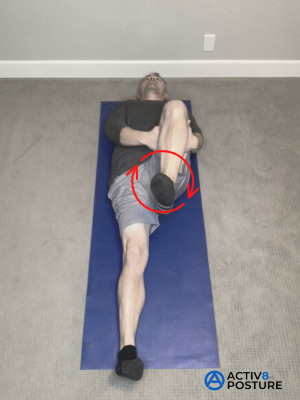
1. Foot Circles and Point Flexes
Lie on your back with one leg straight on the floor. Bring the other knee toward your chest and hold behind the thigh with both hands. Keeping the knee still, circle that foot 20 times in each direction, then point and flex it 20 times. Switch legs. Keep the foot pointing straight up toward the ceiling as you move.
2. Supine Calf and Hamstring Stretch
Lie on your back with one knee bent and that foot flat on the floor. Loop a strap or towel around the ball of the other foot. Keeping that knee straight and your thigh tight, raise the leg until you feel a stretch along the back of the leg, and gently pull your toes toward you with the strap. Keep your kneecap and foot pointing straight up. Hold for 1 minute, then switch sides.
3. Abduction-Adduction
Lie on your back with your hips and knees bent to 90 degrees and your feet on a wall, a few inches apart. Slowly let your knees open apart as your feet roll onto their outer edges, going only as far as is comfortable. Then slowly bring your knees back together and press them gently at the top. Keep your belly relaxed and breathe easily. Repeat 15 to 20 times.

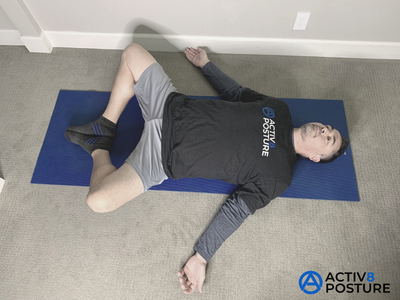
4. Frog
Lie on your back and draw your feet in toward your buttocks, then bring the soles of your feet together and slowly let your knees fall open to the sides, allowing your hips to open. Relax your whole body and breathe into your belly. Hold for 1 to 2 minutes.
Choosing Your Next Step
There’s no single right path. It depends on how you like to work:
- You’d like to start on your own. The checks and exercises above are a sensible place to begin.
- You’d like someone to tell postural from structural. A free 30-minute consultation includes a postural assessment of how you stand and walk. We have clinics in Newton, Gloucester, Santa Monica, Beverly Grove and Middletown, RI.
- You’re not near a clinic. Virtual posture therapy brings the same assessment approach to you.
Frequently Asked Questions About Tibial Torsion
Can tibial torsion be corrected in adults?
Structural tibial torsion, a twist in the bone, doesn’t change with exercise. Postural tibial rotation, where muscle imbalances hold the leg turned, often does change with consistent work from the hips down. That’s why telling the two apart matters.
What’s the difference between tibial torsion and duck feet?
Duck feet describes feet that turn out, whatever the cause. External tibial torsion is one possible cause; hip rotation and foot position are others, and in adults they’re more common.
Is tibial torsion normal in children?
In-toeing from internal tibial torsion is common in toddlers and usually improves as they grow. External tibial torsion is less likely to improve. A pediatrician can check whether a child’s walking is developing normally.
Do I need surgery for tibial torsion?
Almost never. Surgery is reserved for rare, severe structural cases that cause significant problems, and that decision belongs with an orthopedic surgeon.
This article is general education, not medical advice. If you have knee swelling, locking or instability, a limp, or pain that doesn’t settle, see a physician or orthopedist first. For children, start with their pediatrician. Posture therapy works alongside medical care, never instead of it.
Related reading: Leg and Knee Alignment: the complete guide.
Where to go next
- Browse the Posture Dictionary for related terms.
- Not sure where to start? A free 30-minute consultation and posture assessment, at one of our clinics or virtually, is the best first step.