
Rounded Shoulders
Quick answer: Rounded shoulders is a posture in which the shoulders roll forward and inward, ahead of where they’d sit in a balanced posture, usually with the upper back rounding and the head drifting forward. It’s one of the most common posture patterns, especially for people who spend long hours at desks, on phones or driving, and because it comes from habits and muscle balance, it’s something you can work on.
Maybe you’ve noticed your shoulders look hunched in photos, or your shirts pull across the back. Maybe you’ve been told to “pull your shoulders back” so often that you do it automatically, for about thirty seconds. If that sounds familiar, you’re far from alone.
What Are Rounded Shoulders?
With rounded shoulders, the shoulder blades slide forward and outward around the rib cage, and the upper arms turn inward. From the side, the shoulders sit ahead of a line running down from your ear; from the front, the backs of your hands may face forward. It rarely comes alone: rounded shoulders usually travel with a rounded upper back (hunchback) and forward head posture. When tight chest and neck muscles combine with under-used upper-back muscles in this way, it’s sometimes called upper crossed syndrome.

How Do I Know If I Have Rounded Shoulders?
- Knuckle test. Stand relaxed and let your arms hang by your sides. Look down at your hands. If your knuckles face forward, or you can see the backs of your hands, your shoulders are likely rolling in.
- Wall test. Stand with your heels a few inches from a wall and your buttocks touching it. Do your shoulder blades and the backs of your shoulders touch the wall comfortably, or do you have to pull them back to get there?
- Floor test. Lie on your back with your arms by your sides. Do the backs of your shoulders rest on the floor, or lift off it?
- Side-view photo. Are your shoulders ahead of a line from your ear down through your hip?
What Causes Rounded Shoulders?
- Desk, screen and driving time. Arms forward and head down for hours at a time, day after day.
- Muscle balance. Tight chest muscles pull the shoulders forward, while the muscles between and below the shoulder blades aren’t doing their share to hold them back.
- Training habits. Lots of chest and pushing work without matching upper-back work.
- What’s happening below. How the pelvis and hips work changes how the trunk and shoulders sit. See sway back and lateral pelvic tilt.
- Self-consciousness. Some people round their shoulders to feel less exposed, especially during adolescence.

The Hip-Shoulder Connection
One marathon runner we worked with came in for low back pain on her right side. Her assessment showed her right thigh was rotating inward as she ran, and her glute on that side wasn’t firing as it should. Each time that foot landed, her right shoulder dropped and her spine bent to the side to compensate. Over time, even when she wasn’t running, she developed noticeably rounded shoulders, more on the left. The shoulders were where it showed, but the pattern started at the hip.

What Are the Symptoms of Rounded Shoulders?
Some people with rounded shoulders feel fine. When there are symptoms, people commonly describe:
- Tension in the neck and across the tops of the shoulders
- Aching between the shoulder blades
- Discomfort reaching overhead, or a pinching feeling at the front of the shoulder
- Tension headaches
- A tight chest, or difficulty taking a full breath when slumped
See a doctor if you have arm numbness, tingling or weakness, shoulder pain that doesn’t settle, or pain after an injury. If one shoulder blade sticks out noticeably, see our winged scapula entry.

How Do You Fix Rounded Shoulders?
“Pull your shoulders back” is the advice almost everyone has heard, and almost everyone finds it doesn’t last. If your upper back is still rounded and your hips aren’t supporting you, holding your shoulders back is a constant effort, and they drift forward the moment you stop concentrating. Stretching your chest can feel good for a while for the same reason.
What tends to help is changing where the shoulders naturally sit: restoring movement in the upper back, opening the chest, strengthening the muscles that hold the shoulder blades, and addressing how the pelvis and hips support the trunk. How much your posture changes varies from person to person.
Exercises for Rounded Shoulders
Three starting points. Move slowly and stop anything that causes pain.
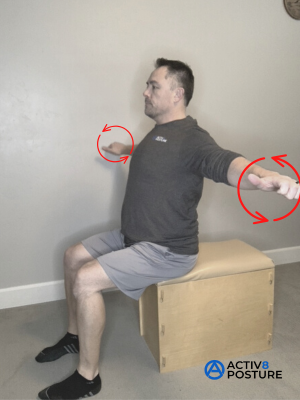
1. Sitting Arm Circles
Sit tall on the front of a chair, rolling your hips forward onto your sit bones with a gentle arch in your lower back. Squeeze your shoulder blades back and down, and curl your fingertips into a loose fist. Raise your arms out to the sides at shoulder height and make small circles rolling up and forward, 25 to 50 times. Then turn your palms up and do the same number rolling up and back.
2. Elbow Curls
Stand or sit tall. Curl your fingertips and rest your knuckles on your temples, thumbs pointing down, chin level. Bring your elbows together in front of your face, then open them back until they line up with your ears. Repeat 20 to 25 times, slowly.

3. Standing Wall Twist
Stand sideways to a wall, about a foot away, with your feet heel to toe and about 6 inches apart. Place both hands on the wall at shoulder width and chest height, elbows raised about 45 degrees. Keep your thighs tight and your weight even between your feet. Rotate your trunk and hips toward the wall, keeping your hands flat, and open your back shoulder by drawing the shoulder blade back rather than pushing with your arms. Hold for 30 seconds to 1 minute, then switch sides.

Choosing Your Next Step
There’s no single right path. It depends on how you like to work:
- You’d like to start on your own. The checks and exercises above are a sensible place to begin.
- You’d like someone to find what’s driving it. A free 30-minute consultation includes a postural assessment of your shoulders and the rest of your body. We have clinics in Newton, Gloucester, Santa Monica, Beverly Grove and Middletown, RI.
- You’re not near a clinic. Virtual posture therapy brings the same assessment approach to you.
Frequently Asked Questions About Rounded Shoulders
Can rounded shoulders be fixed?
Because rounded shoulders usually come from habits and muscle balance, they often change with consistent work on the whole body, not just the shoulders. How much and how quickly depends on the person and how long the pattern has been there.
What muscles cause rounded shoulders?
Usually a combination: tight chest muscles (the pectoralis major and minor) pulling the shoulders forward, and under-used muscles between and below the shoulder blades (the rhomboids, middle and lower trapezius, and serratus anterior) not holding them back.
Does stretching your chest fix rounded shoulders?
It can help you feel more open for a while, but on its own it rarely lasts. If the upper back and hips still pull you forward, the shoulders drift back to where they were.
Are rounded shoulders the same as hunchback?
They’re related but different. Rounded shoulders describes where the shoulders sit; hunchback describes rounding of the upper back. They usually occur together.
This article is general education, not medical advice. If you have arm numbness, tingling or weakness, shoulder pain that doesn’t settle, or pain after an injury, see a physician first. Posture therapy works alongside medical care, never instead of it.
Where to go next
- Browse the Posture Dictionary for related terms.
- Not sure where to start? A free 30-minute consultation and posture assessment, at one of our clinics or virtually, is the best first step.