
Uneven Hips
Quick answer: Uneven hips is when one hip sits higher, sticks out further to the side, or sits further forward than the other. Most often it comes from how the muscles around the pelvis and trunk are balancing you, and from one-sided habits. Less often, one leg is genuinely longer, or a sideways curve of the spine (scoliosis) is involved.
Maybe one side of your waistband always sits lower, one pant leg drags, or your belt buckle drifts off-center. Maybe you’ve noticed that one hip juts out when you stand, or that you always rest on the same leg. If you’re wondering whether that’s connected to a nagging ache on one side, it very often is.
What Are Uneven Hips?
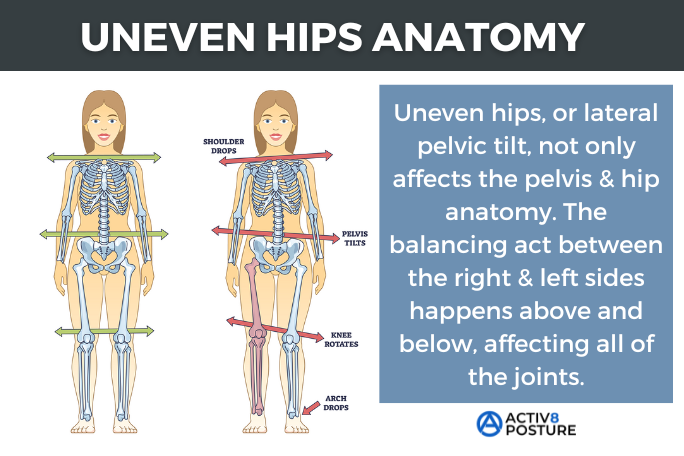
“Uneven hips” is the everyday name for any visible difference between the two sides of the pelvis. It usually shows up in one of three ways, and they often combine:
- One hip higher. One side of the pelvis sits higher than the other, also called a hip hike. The technical term is lateral pelvic tilt.
- One hip sticking out. The pelvis shifts sideways, so one hip juts out further than the other, often with the upper body leaning the opposite way.
- One hip forward. One side of the pelvis is rotated ahead of the other. See pelvic rotation and asymmetrical pelvis.
How Can I Tell If My Hips Are Uneven?
Stand barefoot in front of a full-length mirror, relaxed, with your feet hip-width apart:
- Height. Rest your hands on the top of your hip bones. Does one hand sit higher?
- Side shift. Look at the space between each arm and your waist. Is it bigger on one side? Does one hip stick out further?
- Rotation. Look down at your hip bones at the front. Does one seem further forward than the other?
- Weight. Close your eyes. Do you feel more weight on one leg?
- Clothing clues. A waistband that sits lower on one side, a belt buckle off-center, or one pant leg that seems longer.

Do I Have Uneven Hips or a Longer Leg?
It’s a common question. When one leg is truly longer because the bone is longer, it’s called a structural leg length difference. Small differences are common and often cause no trouble. Much more often, though, the legs are the same length and the hips are simply positioned unevenly, which makes one leg look or feel longer. That’s a functional difference, and it’s the kind that tends to change with posture work. A doctor can measure your legs, sometimes with an X-ray, if you’re unsure. Read more in uneven hips and leg length.
Could Uneven Hips Be Scoliosis?
Sometimes. One hip sitting higher is one of the common signs of scoliosis, especially alongside uneven shoulders, one shoulder blade sticking out, or an uneven waist. If you see several of these, or one side of your back sits higher when you bend forward, see a doctor. See also scoliosis and uneven shoulders.
What Causes Uneven Hips?
- Standing on one leg. Resting your weight on the same leg, especially for long periods, lets the pelvis settle into that position.
- One-sided habits. Carrying a child, bag or tool on the same hip, sleeping on one side, or sitting with the same leg crossed.
- One-sided sports. Golf, tennis, soccer, hockey and other sports that rotate or load one side more.
- Muscle balance. Differences between the two sides in the muscles on the outside of the hips, the inner thighs, and along the side of the lower back.
- What’s happening above and below. One foot rolling in more (overpronation), one knock knee, or old ankle and knee injuries can all tilt or turn the pelvis.
- Structural causes. A true leg length difference or scoliosis.

How Common Are Uneven Hips?
Very common — common enough that a little unevenness is closer to normal than to a fault:
| Finding | What the research shows |
|---|---|
| Level hips are the minority | In 300 young adults, the hip bones sat level in only 32% |
| Small leg-length differences are the norm | About 90% of people have one, averaging around 5 mm — and people with back pain averaged 5.1 mm versus 5.2 mm in people without |
| The pelvis adapts to how you use it | When healthy adults with level pelvises were put through asymmetric loading, 23% developed measurable asymmetry — which the researchers described as a physiologic adaptation, not a pathology |
That’s reassuring, and it points to what matters: not the millimeters, but how your hips, trunk and legs move and share load. That’s what a posture assessment looks at, and what the right exercise changes.
What Are the Symptoms of Uneven Hips?
Many people with uneven hips have no symptoms. When there are symptoms, they tend to appear on one side. People commonly describe:
- Lower back aching, often worse on one side
- Hip or buttock tightness, or discomfort along the outside of one thigh
- Leg discomfort or sciatica that keeps returning on the same side
- Feeling steadier standing on one leg than the other
- Knee or foot discomfort on one side
None of these proves uneven hips are the cause. See a doctor if you have numbness, weakness, pain that travels down your leg, or a new limp. If you’re worried about your balance or falls, ask your doctor about a balance assessment.
How Do You Fix Uneven Hips?
If you’ve tried stretching the tight side or standing “evenly” on purpose, you’ve probably found your hips drift back to their usual position as soon as you stop concentrating. That’s normal. The pelvis sits where it does because of how the whole body has learned to balance.
What tends to help is working on both sides and the whole chain: restoring even movement at both hips, building control that keeps the pelvis level when you stand and walk, and addressing the feet, knees and trunk that feed into it. Changing one-sided habits matters too. How much your hips even out varies from person to person; a structural leg length difference or scoliosis behaves differently, and sometimes a doctor may suggest a shoe lift.
Where to Start With Exercises
- If one hip is higher: start with the standing windmill, abduction-adduction and static wall splits in our lateral pelvic tilt guide.
- If one hip is forward: see our asymmetrical pelvis guide.
- Either way: notice which leg you stand on, which hip you carry on, and which leg you cross. Switching sides is a simple place to start.
Choosing Your Next Step
There’s no single right path. It depends on how you like to work:
- You’d like to start on your own. The checks above and the exercises in the linked guides are a sensible place to begin.
- You’d like someone to find what’s driving it. A free 30-minute consultation includes a postural assessment of how you stand and move. We have clinics in Newton, Gloucester, Santa Monica, Beverly Grove and Middletown, RI.
- You’re not near a clinic. Virtual posture therapy brings the same assessment approach to you.
Frequently Asked Questions About Uneven Hips
Why is one of my hips higher than the other?
Most often because of how the muscles around the pelvis and trunk are balancing you, along with one-sided habits like standing on one leg or carrying on one hip. Less often, one leg is structurally longer or scoliosis is involved.
Are uneven hips the same as lateral pelvic tilt?
Often, yes. A lateral pelvic tilt, where one hip sits higher, is the most common kind of uneven hips. But hips can also look uneven because the pelvis is shifted to one side or rotated, so it’s worth checking all three. See lateral pelvic tilt for more.
Can uneven hips cause back pain?
They can contribute, especially to one-sided back, hip or leg discomfort, because the two sides of the body end up loaded differently. But back pain has many causes, so if yours is persistent, severe, or comes with leg symptoms, see a doctor.
Can uneven hips be corrected?
When the difference is functional, from muscle balance and habits, it often changes with consistent work on the whole body. A structural leg length difference won’t change, but how your body organizes around it still can.
This article is general education, not medical advice. If you have leg numbness or weakness, pain that travels down your leg, a limp, signs of scoliosis, or a suspected leg length difference, see a physician or orthopedist first. Posture therapy works alongside medical care, never instead of it.
Sources
- Gnat R, Saulicz E, Biały M, Kłaptocz P. Does pelvic asymmetry always mean pathology? Analysis of mechanical factors leading to the asymmetry. Journal of Human Kinetics 2009;21:23–35. doi:10.2478/v10078-09-0003-8
- Bibrowicz K, et al. Asymmetry of the pelvis in Polish young adults. Frontiers in Psychology 2023;14:1148239. doi:10.3389/fpsyg.2023.1148239
- Knutson GA. Anatomic and functional leg-length inequality: a review and recommendation for clinical decision-making. Part I. Chiropractic & Osteopathy 2005;13:11. doi:10.1186/1746-1340-13-11
Related reading: Pelvic Tilt, Uneven Hips and Lower-Back Posture: the complete guide.
Where to go next
- Browse the Posture Dictionary for related terms.
- Not sure where to start? A free 30-minute consultation and posture assessment, at one of our clinics or virtually, is the best first step.