

Vastus Lateralis: Anatomy, and Why Outer Thigh Pain Often Is Not It
Quick answer: The vastus lateralis is the largest of the four quadriceps muscles. It runs down the outside of the thigh from the upper femur — the intertrochanteric line, greater trochanter, gluteal tuberosity and lateral lip of the linea aspera — and inserts into the base of the patella through the quadriceps tendon, with some tendinous fibers continuing to blend with the iliotibial tract and attach to the lateral condyle of the tibia. It is supplied by the femoral nerve (L2–L4) and it extends the knee. Two things are worth knowing beyond the anatomy: that iliotibial connection is why vastus lateralis and IT band problems are so often confused, and pain on the outside of the thigh is frequently not this muscle at all.
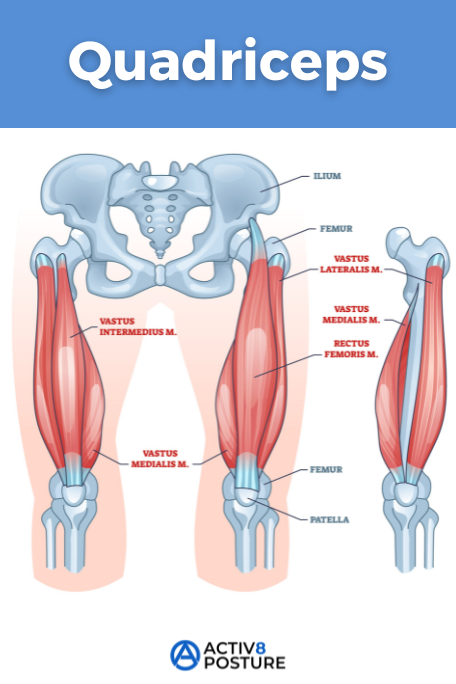
Vastus Lateralis Anatomy
| Feature | Detail |
|---|---|
| Origin | Proximal half of the intertrochanteric line; anterior and inferior borders of the greater trochanter; lateral lip of the gluteal tuberosity; proximal half of the lateral lip of the linea aspera |
| Insertion | Base of the patella via the quadriceps tendon. Some tendinous fibers descend to the proximal tibia and blend with the iliotibial tract, inserting into the lateral condyle of the tibia |
| Innervation | Femoral nerve, L2–L4 |
| Blood supply | Branches of the lateral circumflex femoral artery, the quadriceps artery, and the first perforator of the deep femoral artery |
| Action | Knee extension, as part of the quadriceps group — the most powerful knee extensor |
| Size | The largest of the four quadriceps muscles |
| Position | Lateral thigh, beneath the iliotibial band through much of its length |
Anatomy as described in standard references (Kenhub).
What People Mean by the Vastus Lateralis Tendon
This is one of the most searched questions about the muscle, and the answer is less tidy than the phrase suggests. The vastus lateralis does not have a single discrete tendon of its own running to the knee. Its tendinous fibers do two things:
- They merge into the quadriceps tendon, the common tendon all four quadriceps heads form above the patella. Pain described as being in the “vastus lateralis tendon” just above and lateral to the kneecap is usually quadriceps tendon territory.
- Some fibers continue past the knee and blend with the iliotibial tract, attaching to the lateral condyle of the tibia. This is the anatomical reason the muscle and the IT band are not cleanly separable structures on the outside of the thigh.
That second point has a practical consequence. People trying to work out whether their lateral thigh problem is “the muscle” or “the IT band” are asking a question the anatomy does not fully support, because the two are continuous. The more useful question is where exactly the pain is and what provokes it — which is the next section.
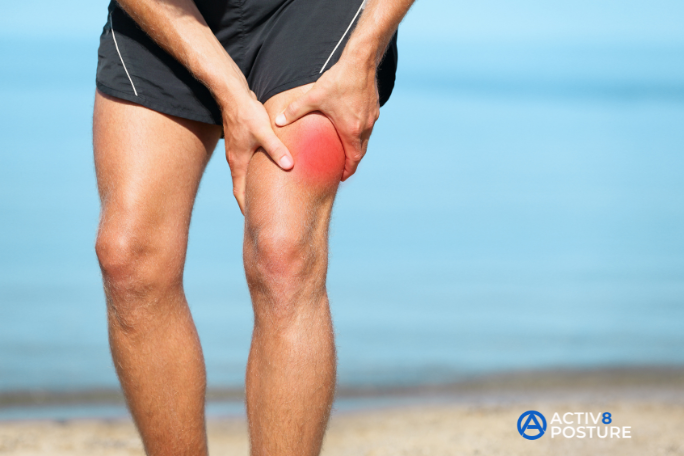
Pain on the Outside of the Thigh Is Often Not This Muscle
If you searched for vastus lateralis pain, the single most useful thing this page can give you is the list of things that produce pain in the same place and are more common. Several of them respond to completely different treatment, and one of them is a nerve rather than a muscle.
| What it may be | Where and how it presents | What points to it |
|---|---|---|
| Greater trochanteric pain syndrome | Tenderness over the bony point at the side of the hip | Pain lying on that side at night is the giveaway. Often with hip abductor weakness. Found in 44.9% of people with chronic low back pain versus 6% of controls |
| Iliotibial band syndrome | Lower outer thigh, close to the outside of the knee | Comes on with repetitive activity — running, cycling — and more common in younger runners |
| Meralgia paresthetica | Front and outside of the thigh | Numbness, tingling or itching more than pain, and people can trace the exact patch with a finger. No weakness, because the nerve has no motor fibers. Associated with tight waistbands, obesity, diabetes |
| Lumbar nerve root irritation | Outer thigh, often continuing below the knee | Numbness, tingling or weakness alongside the pain. Coming from the back rather than the leg |
| Lumbar spinal stenosis | Can present as lateral thigh pain in 42% of cases | Eases when you bend forward — the classic version is being comfortable leaning on a shopping cart. Affects up to 20% of adults aged 60–69 |
| Hip osteoarthritis | Usually groin, but lateral hip in 27% of cases | Pain when someone moves your hip passively while you lie down |
| Quadriceps tendon problem | Just above and often lateral to the kneecap | Pain loading the knee — stairs, squatting, jumping — localized to the tendon above the patella |
That differential is drawn from a stepwise review of lateral hip and thigh pain (Pain Medicine). Two findings in it are worth pulling out.
The hip one is widely mistreated. Greater trochanteric pain syndrome used to be called trochanteric bursitis, and only about 20% of cases involve true bursitis. Most of it is gluteal tendon problems, usually sitting on top of relative hip abductor weakness — which is why injections are not first-line. In the figures cited, hip abductor strengthening produced an 80% success rate against 48% for injection at 15 months.
The nerve one is easy to identify yourself. If the dominant sensation is numbness, tingling or itching rather than ache, and you can trace the patch precisely with a fingertip, and nothing is weak, that pattern points at the lateral femoral cutaneous nerve rather than at any muscle. Foam rolling will not help it. Loosening a tight waistband sometimes does.
What the Research Says About Knee Pain and This Muscle
There is one claim that dominates almost everything written about the vastus lateralis, including an earlier version of this page. It goes like this: the vastus lateralis is stronger than the vastus medialis on the inside of the knee, so it overpowers it and drags the kneecap outward, and the fix is to selectively strengthen the vastus medialis — the VMO — to restore the balance.
It is a tidy story, and the anatomy supports part of it: the lowest fibers of the vastus medialis do run almost horizontally and help counter the outward pull of the other three heads. The good news is that the fix is simpler than the story suggests.
Clinical guidance is clear on this: “Do not use specific exercises of selective strengthening of the vastus medialis obliquus (VMO) in patellofemoral pain syndrome.” The reasons given are that selectively activating the VMO isn’t achievable, that symptoms don’t track with VMO strength or activation, and that general quadriceps strengthening is equally effective while selective programs are “considerably more complex, expensive and time-consuming” (Choosing Wisely). Reviews of muscle-activity studies agree that the VMO can’t be singled out.
So: you cannot isolate the muscle the theory says to isolate, its strength does not track with whether people hurt, and the simpler alternative works as well. Three independent reasons the plan fails, any one of which would be sufficient.
So you don’t need to chase one muscle. Strengthening the whole quadriceps, together with the hips, is simpler, and it works.
What Is Actually Recommended for Kneecap Pain
The useful news is that the alternative is better evidenced and less fiddly. From the 2018 international consensus statement on patellofemoral pain (5th International Patellofemoral Pain Research Retreat):
- Exercise therapy is recommended to reduce pain in the short, medium and long terms, and to improve function in the medium and long terms.
- Combining hip and knee exercises is recommended, and should be used in preference to knee exercises alone. That is the consensus wording, not our paraphrase.
- Combined interventions — exercise plus orthoses, taping or manual therapy — are recommended to reduce pain in the short and medium terms.
- Foot orthoses are recommended for short-term pain reduction; the supporting evidence is for prefabricated orthoses rather than custom-made ones.
- Patellofemoral, knee and lumbar mobilizations are not recommended in isolation.
- Electrophysical agents are not recommended.
- Taping and bracing, dry needling, soft tissue techniques, blood flow restriction and gait retraining are all listed as uncertain pending more research.
Note what the second point means for a page about a thigh muscle: the guideline-level recommendation is not to train the knee in isolation. Strengthening above the knee as well as around it is the recommended approach, by consensus, for the commonest reason people end up reading about their quadriceps. That is a legitimate whole-chain argument, and it is a much better one than the VMO story it replaces.
When to Get Lateral Thigh Pain Assessed
- Weakness in the leg, a foot that drags or catches, or a knee that gives way — weakness with pain needs assessment rather than exercise, and nerve-root involvement with weakness is treated as urgent.
- Numbness or tingling, particularly if it extends below the knee or you can map a distinct patch.
- Pain that eases when you bend forward and builds when you walk upright — a pattern suggesting the spine rather than the thigh.
- Night pain lying on that side that is getting worse rather than fluctuating.
- Sudden severe thigh pain after a fall, or inability to bear weight.
- Swelling, warmth, redness or calf tenderness — needs ruling out rather than working around.
- Unexplained weight loss, night sweats or fever alongside the pain.
Where the Rest of the Leg Comes In

Given that the consensus recommends training the hip alongside the knee, the patterns worth looking at are the ones that change how load arrives at the knee in the first place:
| Pattern | How it reaches the lateral thigh and knee |
|---|---|
| Knee drifting inward under load | Changes where the kneecap tracks as you squat, land or descend stairs. Associated with hip abductor control as much as with anything at the knee |
| Restricted ankle dorsiflexion | If the shin cannot travel forward over the foot, the knee and hip have to find the motion elsewhere — and the compensations show up at the knee |
| Foot rolling inward | Rotates the shin inward, which changes kneecap tracking from below |
| Lateral pelvic tilt and uneven hips | Alters how load distributes between legs, which is often why one side is symptomatic and the other is not |
| Hip abductor weakness | The factor behind most greater trochanteric pain syndrome, and the one with the 80% versus 48% figure attached to it |
This is where a whole-body approach helps: the knee sits between a hip and an ankle, and the consensus guidance says to train above it as well as around it. See also knee pain and conservative care and body asymmetry.
Frequently Asked Questions
What is the origin and insertion of the vastus lateralis?
It originates from the proximal half of the intertrochanteric line, the anterior and inferior borders of the greater trochanter, the lateral lip of the gluteal tuberosity, and the proximal half of the lateral lip of the linea aspera. It inserts into the base of the patella via the quadriceps tendon, and some of its tendinous fibers continue to blend with the iliotibial tract and attach to the lateral condyle of the tibia.
What nerve supplies the vastus lateralis?
The femoral nerve, carrying fibers from spinal levels L2 to L4 — the same nerve that supplies all four quadriceps heads.
What does the vastus lateralis do?
It extends the knee, working with the other three quadriceps heads, which together form the most powerful knee extensor. It is the largest of the four. Because it sits on the outer thigh and its fibers blend into the iliotibial tract, it also contributes to how load is handled on the lateral side of the knee.
Is there a separate vastus lateralis tendon?
Not really a discrete one. Its tendinous fibers merge into the quadriceps tendon above the kneecap, and some continue past the knee into the iliotibial tract to reach the lateral tibia. Pain described as being in the vastus lateralis tendon, just above and lateral to the kneecap, is usually in quadriceps tendon territory.
Why does the outside of my thigh hurt?
Often not because of this muscle. The commoner candidates are greater trochanteric pain syndrome (giveaway: pain lying on that side at night), iliotibial band syndrome (lower outer thigh, after running or cycling), meralgia paresthetica (numbness or tingling more than pain, in a patch you can trace precisely, with no weakness), and referral from the lumbar spine (pain continuing below the knee, or easing when you bend forward). Each needs something different, so working out which it is comes before treating it.
Should I do VMO exercises to balance out my vastus lateralis?
No, and this is well established. A formal recommendation advises against selective VMO strengthening for patellofemoral pain, for three reasons: the VMO cannot be selectively activated relative to the other quadriceps, there is no correlation between symptoms and VMO strength or activation, and general quadriceps strengthening is equally effective while being much simpler and cheaper. The popular story about the vastus lateralis overpowering the VMO does not survive the evidence.
What actually helps kneecap pain then?
Exercise therapy, which the 2018 international consensus recommends for reducing pain in the short, medium and long terms. Specifically, combining hip and knee exercises is recommended in preference to knee exercises alone. Prefabricated foot orthoses are recommended for short-term pain reduction; custom ones lack evidence. Mobilizations in isolation and electrophysical agents are not recommended.
Can you stretch or foam roll the vastus lateralis and IT band loose?
The structures are continuous rather than separate, so the mental model of releasing one of them is shakier than it sounds. The 2018 consensus lists manual soft tissue techniques among the interventions where evidence is uncertain — neither endorsed nor ruled out. If rolling makes you feel better before training, there is no reason to stop; just do not expect it to be the thing that resolves a persistent problem, and do not use it on what turns out to be a nerve.
Is the vastus lateralis used for injections?
Yes. The CDC names the vastus lateralis in the anterolateral thigh as the site for intramuscular injections in infants, specifying the middle third of the muscle — above the lateral condyle and below the greater trochanter — and noting that no large blood vessels are present there (CDC). It is chosen for being large, easy to locate and safe to needle, which has nothing to do with thigh pain but is a common reason people look the muscle up.
Is a bigger vastus lateralis a problem?
No. It is the largest quadriceps head in everyone, and a visibly developed outer thigh in someone who trains is a training adaptation rather than an imbalance to correct. For knee pain, building strength across the whole thigh and hip is what helps.
Where to Start
- If you came for the anatomy — origin, insertion, nerve, action — it is in the table above and you owe us nothing.
- If something on the outside of your thigh hurts, work through the differential first. Night pain lying on that side, pain below the knee, a traceable numb patch, or relief on bending forward each point somewhere other than this muscle.
- If anything on the assessment list applies, particularly weakness or numbness, see a physician before starting any exercise program.
- If it is kneecap pain, the recommended route is exercise therapy combining hip and knee work — not selective VMO training, which is specifically advised against.
That last case is where we are a sensible fit, and the claim we are making is the consensus one rather than a proprietary one: train the hip alongside the knee, assess how the whole leg loads, and progress it over time. Our posture assessment sets out what we look at, and posture therapy explains how the programs are structured.
If an assessment suggests the problem is the hip joint, a nerve, or coming from your back, we refer out and tell you so. A free consultation is a conversation, not a commitment.

Sources
- Quadriceps femoris muscle: anatomy, innervation, function — Kenhub. Origin, insertion, the iliotibial blend, innervation, blood supply, and the vastus medialis oblique fibers.
- Do not use specific exercises of selective strengthening of the vastus medialis obliquus (VMO) in patellofemoral pain syndrome — Choosing Wisely. A formal do-not-do recommendation, citing systematic reviews of EMG studies on whether the VMO can be preferentially activated.
- 2018 Consensus statement on exercise therapy and physical interventions to treat patellofemoral pain — 5th International Patellofemoral Pain Research Retreat. What is recommended, what is not recommended in isolation, and what remains uncertain.
- Deconstructing Chronic Low Back Pain in the Older Adult, Part VIII: Lateral Hip and Thigh Pain — Pain Medicine. The differential diagnosis, the bursitis-versus-tendinopathy figures, and the hip abductor strengthening comparison.
- Vaccine Administration: Intramuscular Injection, Infants — Centers for Disease Control and Prevention. The injection site.
This article is for general information and is not a substitute for individual assessment. Thigh pain with weakness, numbness, or pain radiating below the knee should be assessed by a clinician rather than treated with exercise.


