

Pain and the Map of Consciousness: A Posture Therapy View

Some links below are affiliate links. As an Amazon Associate, Activ8 Posture earns from qualifying purchases, at no extra cost to you. See our affiliate disclosure.
If you are reading this while shifting in your seat, looking for a position that does not aggravate your pain, you already know that chronic pain is not only a mechanical problem. It affects mood, outlook and how you move through your day — and those things affect the pain in turn.
Pain is physical, but not only physical
We are taught to think of pain as purely structural — damaged tissue, compressed nerves, inflamed joints. Yet many people have surgeries, injections and years of physical therapy and still hurt. Modern pain science offers part of the explanation: persistent pain involves the nervous system, expectation and stress, not just the tissue where you feel it.
At Activ8 Posture we see this regularly. Clients who resolve their physical pain often report changes that go beyond the symptom — sleeping better, feeling less on edge, wanting to do things they had stopped doing. Posture alignment therapy works on the structure, but the structure is not separate from how you feel.
Why symptom-based care often falls short
You have probably been there: another appointment, another prescription, another session focused on where it hurts rather than why. Conventional medical care is excellent for acute injury and emergencies. For long-standing pain, a symptom-focused approach can leave people stuck.
- Pain gets treated as an isolated problem rather than a whole-body one
- Medication eases symptoms but works best alongside work on what is driving them
- The focus falls on temporary relief rather than lasting change
- The emotional side of living with pain goes unaddressed
This is not a criticism of individual clinicians, most of whom are working within real constraints. But if you have been told “it’s just part of aging” or “learn to live with it”, it is reasonable to think something is missing.
The body–mind link in chronic pain
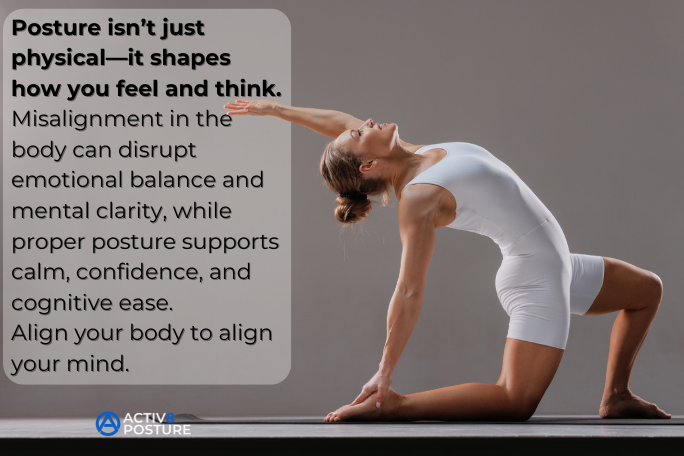
Emotional states show up in posture. This is observable and uncontroversial:
- Fear contracts the chest, rounds the shoulders and shortens the breath
- Shame collapses the spine and carries the head forward
- Anger tightens the jaw, neck and upper back
- Grief closes the chest and disengages the core
Held long enough, these temporary responses become habitual patterns. The body adapts to the position it spends most time in. That is part of why treating the painful area alone often does not hold — you are working against a pattern that has been reinforced for years.
The practical implication is encouraging: working on physical alignment can be a way into a pattern that is hard to change by thinking about it. Changing how you hold yourself changes how you breathe, and breathing is one of the few direct levers on the nervous system.
Hawkins’ Map of Consciousness as a lens
Dr David Hawkins’ Map of Consciousness places human emotional states on a scale, from shame and apathy at the bottom, through fear, anger and pride, up to courage, acceptance, reason, love and peace.
A note on the science. Hawkins derived his numerical calibrations using applied kinesiology — muscle testing — which is not an accepted measurement method, and the specific numbers are not scientifically validated. We are not presenting the scale as science, and we do not calibrate anyone. What we find useful is the ordering: the observation that emotional states form a rough progression, and that people in pain often recognize where they sit on it.
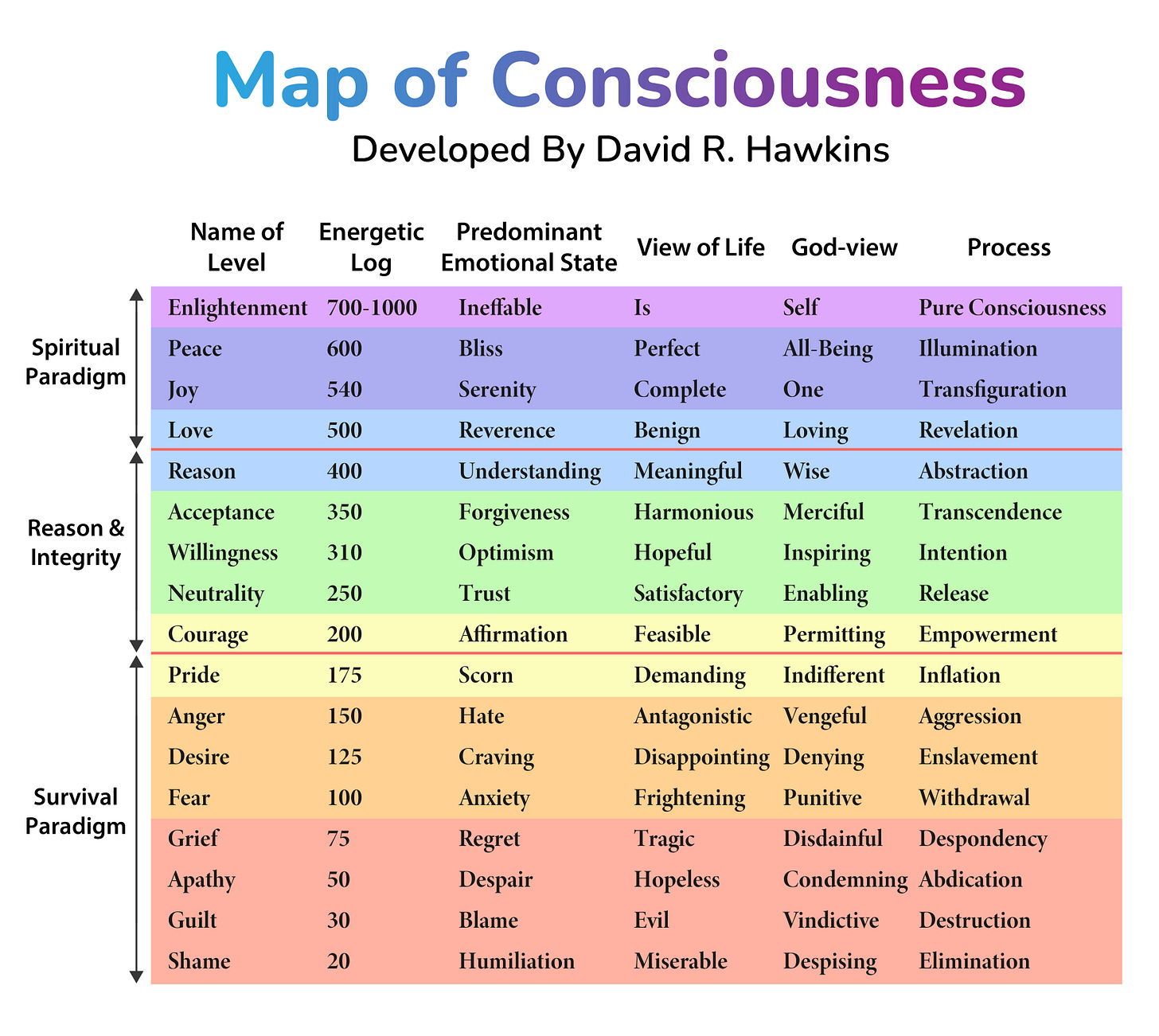
Read as a description rather than a measurement, the pattern is recognizable. People living with long-term pain often describe themselves as stuck in survival, fear or frustration. Moving from “this is happening to me” toward “I can do something about this” is a real and meaningful shift, whatever you call it.
What actually changes, in our experience
From survival to stability
Many clients arrive with pain dominating their thinking. They have lost confidence in their body, and their posture reflects it — collapsed, guarded, braced. Through assessment and targeted corrective work, the first shift is usually practical: reconnecting with the body rather than fighting it, restoring some stability, and regaining a sense of agency as the pain starts to ease.
One client, a teacher in her fifties who came to us after a failed back surgery, put it this way after several weeks of posture therapy: “I don’t just feel less pain. I feel like myself again.”
From bracing to breathing
As alignment improves, the nervous system tends to settle out of a constant fight-or-flight posture. What clients notice:
- Easier breathing as the ribcage opens and the diaphragm can move properly
- Less guarding as the body stops bracing against anticipated pain
- Clearer thinking, which tends to follow from sleeping better and hurting less
- More tolerance for activity, which builds on itself
Getting your life back
The changes people mention most are ordinary ones: gardening again, sleeping through the night, playing with grandchildren, going back to a sport. Another client, who came in for neck pain, said: “I came for neck pain. I left with my life back.”
Individual results vary. Change happens at different rates for different people, and nothing here is a promise of a particular outcome or timeline. More client experiences are on our about page.
Why this approach often works when others haven’t
We look at the whole person
Where you feel pain is often not where the problem started:
- Hip pain can originate at the foot
- Headaches can trace back to pelvic position
- Restricted breathing can keep the nervous system on alert
- Fatigue can come from the extra effort inefficient posture demands
We work on causes rather than sites
- A full-body postural assessment
- A program built for your specific pattern, not a generic protocol
- Breathing work, because it affects both mechanics and stress
- Movement re-education so the change carries into daily life
We aim to make ourselves unnecessary
Rather than building dependency, we teach you to read your body’s signals, check your own alignment, and keep up a daily practice of 20 to 40 minutes. The goal is that you can manage this yourself. For the wider picture on natural pain relief, or if you want to read further, Pain Free covers similar ground.
Where to go next
- Browse Posture & Alignment for more on this topic.
- Read how we correct posture.
- Not sure where to start? A free 30-minute consultation and posture assessment, at one of our clinics or virtually, is the best first step.


