

Achilles Tendinitis or Tendinopathy? Why Location Decides Treatment
Quick answer: Two things decide almost everything about Achilles tendon pain, and most articles skip both. First, it is usually not an inflammation problem — the tissue shows degenerative change rather than classical inflammation, which is why clinicians say tendinopathy rather than tendinitis, and why resting and waiting rarely resolves it. Loading the tendon is the treatment. Second, exactly where it hurts changes the odds dramatically. Pain in the body of the tendon, more than 2 cm above the heel bone, responds very well to eccentric loading programs — studies report 89–100% return to pre-injury activity. Pain right at the heel bone is a different problem with the same name, and the identical program produces far worse results. Work out which one you have before you start anything.

Find Out Which One You Have First
Sit down, reach behind your ankle and press along the tendon from the heel bone upward. Note where the tenderness actually is.
| Feature | Midportion | Insertional |
|---|---|---|
| Where it hurts | The body of the tendon, roughly 2–6 cm above the heel bone — you can pinch the sore spot between finger and thumb | Right at the back of the heel bone itself, where the tendon attaches |
| Often described as | A thickened, sore band above the heel | Pain at the bony prominence, often aggravated by shoe backs |
| Eccentric heel-drop programs | Strong results — 89–100% returned to pre-injury activity across Alfredson’s studies | Poor results — a weighted mean improvement of 2.7 points on a 10-point pain scale, with only 42% satisfied or extremely satisfied across three studies |
| Added benefit of eccentric work | Substantial | In a randomized trial, adding eccentric training to conventional care made no significant difference on any outcome |
| Dropping the heel below a step | Part of the tested protocol | Modified protocols avoid loading into that end-range position; the usual explanation is compression of the tendon against the heel bone, though that mechanism is proposed rather than settled |
| What tends to help | Progressive loading | Conventional measures — stretching, ice massage, night splints and heel lifts — appeared sufficient in that trial |
Those figures come from a clinical review of insertional Achilles rehabilitation (Lower Extremity Review) summarizing the underlying trials. Note what it means practically: if your pain is at the heel bone and you spend twelve weeks doing heel drops off a step because that is what the internet prescribes, the evidence predicts you will be disappointed. That is the most expensive mistake available on this topic, and it is entirely avoidable by pressing on your own tendon for ten seconds.
Midportion is the version most research has studied and most advice is written for. If your tenderness sits in the band above the heel, the rest of this page applies to you fairly directly.
Why Clinicians Stopped Calling It Tendinitis
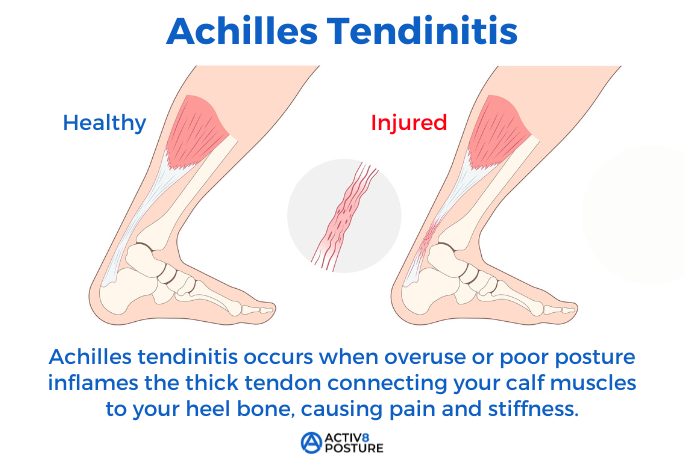
“Tendinitis” means inflammation of a tendon, and the suffix turned out to be wrong for most cases. Tissue taken at surgery shows degenerative change — disrupted collagen fiber structure and increased glycosaminoglycans, which hold water and make the tendon swell — rather than the inflammatory picture the name implies. Even the early, irritable stage is described as a non-inflammatory proliferative response in the cell matrix (Physiopedia).
The current model describes a continuum: a reactive stage, a disrepair stage, then degenerative tendinopathy. It is a continuum rather than a ladder — tendons move along it in both directions depending on how they are loaded.
This is not pedantry, because the name shapes what people do. If you believe the problem is inflammation you rest it, ice it, and take anti-inflammatories, and then wonder why it returns the moment you go back to running. If the problem is a tendon that has become less able to tolerate load, the answer is to rebuild that tolerance — which means loading it, carefully and for longer than you want to.
We have kept “tendinitis” in the title of this page because it is the word people search for. It is just not the word that describes what is happening.
What Achilles Tendon Pain Behaves Like
A few features are characteristic enough to be worth recognizing:
- Morning pain and stiffness is the hallmark. The first steps out of bed are the worst part of the day, and it eases as you move.
- It warms up. Pain often reduces during activity, then returns worse several hours afterward or the next morning. That delayed response is the signal to pay attention to, not how it feels mid-run.
- Localized tenderness. You can usually put a finger on it. Pain that is vague, diffuse, or spread across the whole back of the leg is less typical.
- Swelling and obvious pain at rest are less common than people expect.
- It responds to load, not to time. Weeks of complete rest often feel better and then fail on return, because resting reduces the demand without rebuilding the capacity.
Risk factors recorded in the literature go well beyond running volume: rapid changes in load, type 2 diabetes, high blood pressure, obesity and higher waist circumference, prolonged steroid use, older age, family history, and a specific collagen gene variant. Which is worth knowing because “I barely even run” is a common and entirely reasonable objection from people who have it.
What the Loading Research Actually Tested
Achilles tendinopathy is unusual among the conditions covered on this site: it has a genuinely well-evidenced exercise treatment. It is worth knowing what the studied programs involved, because the version that circulates online is usually a vague instruction to “do eccentric heel drops” with no indication of the dose.
The Alfredson protocol, the one most often referenced: eccentric heel drops on the affected side, three sets of 15 repetitions, twice daily, with both a straight and a bent knee — 180 repetitions a day — for 12 weeks. Non-disabling pain during the exercise is permitted rather than avoided, and load is progressed by adding weight in a backpack in 5 kg increments once the movement becomes comfortable (BMC Musculoskeletal Disorders).
A hundred and eighty repetitions every day for three months is a real commitment, and the researchers themselves note it is a time burden that can compromise adherence — which matters, because an exercise program nobody completes has no effect size at all.
The reassuring part: the details matter less than the dogma suggests
- A less stringent “do-as-tolerated” eccentric protocol produced equal improvements in a later study. You do not necessarily need the full 180.
- Heavy slow resistance training is reported as equally effective as eccentric training — fewer repetitions, heavier load, slower tempo.
- The Silbernagel approach uses both concentric and eccentric heel raises, two-legged and single-legged, three sets of 15 but once daily for 12 weeks, keeping pain below 5 out of 10 and progressing to single-leg and then jumping work.
- A systematic review found little evidence that the eccentric (lowering) part is what matters, and no single regimen has been shown to be best. What the evidence supports is loading the tendon progressively and heavily enough, at least three times a week.
That is good news, because it gives you options: the tendon needs progressive load over months, and which kind of loading you use matters much less than doing it consistently and heavily enough for long enough. If heel drops off a step aggravate you, which they often do in insertional cases, that is a reason to change the exercise, not to conclude that loading has failed.
We have deliberately not written a prescription here. Dose, progression and which variant suits you depend on where your pain is, how irritable the tendon currently is, and what you are trying to get back to — and those are judgments for whoever is managing it with you. Take the protocol details above as what the research tested, not as instructions.
Expect Months, Not Weeks
Every protocol with good results ran for twelve weeks, and twelve weeks was the measurement point rather than the finish line. Tendons adapt slowly because the tissue itself turns over slowly. Progress is also not linear: a flare after a heavier week is normal and is not evidence the program is wrong.
If someone offers to resolve an Achilles problem in two weeks, they are describing something other than what the research has produced.
Get Urgent Assessment for a Possible Rupture
An Achilles rupture is not a worse version of tendinopathy, it is a different event, and it is missed more often than you would expect. Ruptures are misdiagnosed as ankle sprains in 20% to 25% of patients (StatPearls). Seek same-day care if:
- You felt a sudden snap or heard an audible pop at the back of the ankle, often described as feeling like being kicked in the lower leg.
- You cannot stand on the toes of that leg, or push-off is obviously weak.
- There is a palpable gap or dip in the tendon, or bruising around the back of the ankle.
A clinician will usually use the Thompson test — squeezing the calf with you lying face down and the knee bent, watching whether the foot moves. If the foot does not plantarflex, that points to a tear. The test is reported as 96–100% sensitive and 93–100% specific, so it is both quick and informative. If a clinician has told you it was a sprain but you cannot rise onto that toe, it is reasonable to ask again.
Two Medication Associations Worth Knowing
Fluoroquinolone antibiotics. Ciprofloxacin, levofloxacin, ofloxacin and relatives are associated with Achilles tendon problems including rupture. A 2024 meta-analysis of 12 studies and 439,299 patients found the absolute rates were low for most of the class — about 0.17% for levofloxacin and ciprofloxacin — but notably higher for ofloxacin at 1.40%. The mean interval from starting the antibiotic to symptoms was 11 ± 5 days, with most problems appearing within a month. Risk was higher over age 60, and with renal failure, organ transplantation, immunodeficiency, or corticosteroids taken at the same time (EFORT Open Reviews).
Proportion matters here. These are uncommon events and this is not a reason to decline a needed antibiotic. It is a reason to mention the timing if your Achilles pain began within a few weeks of a course of one, because that changes how cautiously the tendon should be loaded.
Corticosteroids. Prolonged corticosteroid use is a recognized risk factor for rupture, and injection directly into or around the Achilles is generally avoided for that reason. If an injection is proposed, it is a fair question to ask what the plan is and why this tendon is an exception.
How Posture and the Ankle Fit In

Achilles problems can be linked to how you load and move, and the whole leg is part of that picture: ankle range, how the foot behaves under load, and hip and calf strength. The research on any single factor is still mixed, so it helps to look at each one rather than assume a single cause.
The specific claim people reach for is restricted ankle dorsiflexion. It is plausible and it is genuinely unresolved. In a review of dorsiflexion and injury risk, reduced dorsiflexion raised Achilles tendinopathy risk in footballers — while in military males, increased dorsiflexion predicted higher risk (European Journal of General Medicine). When a link points in opposite directions in different groups, it is best treated as one factor to check rather than a single cause. The review’s own rating of the evidence linking ankle flexibility to injury is moderate, and it lists Achilles tendinopathy specifically among the conflicting findings.
So a stiff ankle may be part of your picture, and ankle dorsiflexion is worth measuring because it responds to work. Treat it as one contributing factor: loading the tendon is still the main treatment, and work on the rest of the chain supports it.
Where We Fit
| Where we stand | Detail |
|---|---|
| The loading program is the primary treatment | It is the best-evidenced treatment available for this condition and it belongs with whoever is managing your tendon: a physical therapist, sports physician or podiatrist. Our work fits alongside it. |
| Posture and movement work supports the loading program | It can address contributing factors such as ankle range, foot mechanics and hip and calf strength, while the loading program does the main work on the tendon. |
| What we do look at | How the whole leg loads — ankle range, how the foot behaves under load, hip and calf strength, and what you are doing across a day. Those are contributing factors worth addressing, particularly for someone whose tendon keeps flaring on return to running. |
| When that is useful | Alongside a loading program, or after one, especially if this is a recurring problem rather than a first episode. Many of our clients work with us at the same time as other care. |
| When it is not | A first acute episode, a possible rupture, or any case where you have not yet had the tendon properly assessed and a loading plan set up. Start there. |
Related: pronation, turned-out feet, muscle imbalance and knee pain and conservative care — all of which share the ankle and foot mechanics discussed above.
Frequently Asked Questions
Is it Achilles tendinitis or tendinopathy?
Tendinopathy is the accurate term. Tissue examined at surgery shows degenerative change — disrupted collagen and increased glycosaminoglycans causing swelling — rather than classical inflammation, and even the early irritable stage is described as a non-inflammatory response. The distinction matters because it changes the treatment: a tendon that has lost load tolerance needs loading, not rest and anti-inflammatories.
How do I know if mine is insertional or midportion?
Press along the tendon. Midportion tenderness sits in the body of the tendon, roughly 2 to 6 cm above the heel bone, and you can usually pinch the sore spot. Insertional pain is right at the back of the heel bone where the tendon attaches, and is often aggravated by the back of a shoe. It is worth ten seconds of your time, because the two respond very differently to the same exercise program.
Do eccentric heel drops work?
For midportion tendinopathy, yes — Alfredson’s studies reported 89 to 100% return to pre-injury activity. For insertional tendinopathy the same protocols produced a weighted mean improvement of only 2.7 points on a 10-point pain scale with 42% satisfied, and one randomized trial found adding eccentric training to conventional care made no significant difference at all. Where pain is at the insertion, protocols are usually modified to avoid loading into full dorsiflexion.
What was the original Alfredson protocol?
Three sets of 15 eccentric heel drops, twice a day, with the knee both straight and bent — 180 repetitions daily — for 12 weeks, permitting non-disabling pain during the exercise, with load added via a weighted backpack in 5 kg increments as it became comfortable. The researchers acknowledge that volume is a burden that can compromise adherence, and a later less stringent do-as-tolerated version produced equal improvements.
Is heavy slow resistance better than eccentric training?
Reported as equally effective, with fewer repetitions at heavier loads and a slower tempo. Reviews have found little evidence that the eccentric part specifically is what matters, and no single regimen has been shown to be best. What the evidence supports is progressive, sufficiently heavy loading at least three times a week, which means you have options if one variant aggravates you.
How long does Achilles tendinopathy take to get better?
Think in months. Every protocol with good published results ran for 12 weeks, and that was the measurement point rather than the end of recovery. Tendon tissue adapts slowly. A flare after a heavier week is normal rather than a sign the plan is wrong. Anyone promising resolution in a couple of weeks is describing something other than what the research produced.
Should I rest it?
Complete rest is the intuitive answer and usually the wrong one. Resting reduces the demand on the tendon without rebuilding its capacity, which is why pain often settles during a layoff and returns as soon as you resume. Reducing aggravating load temporarily while starting progressive loading is a different thing from stopping. If every option hurts, that is a reason to get it assessed rather than to wait it out.
Can antibiotics cause Achilles tendon problems?
Fluoroquinolones — ciprofloxacin, levofloxacin, ofloxacin and relatives — are associated with Achilles tendinopathy and rupture. A 2024 meta-analysis across 439,299 patients found low absolute rates for most of the class, around 0.17% for levofloxacin and ciprofloxacin, and 1.40% for ofloxacin. Symptoms appeared a mean of 11 days after starting, mostly within a month, with higher risk over age 60 and alongside corticosteroids. Uncommon, but worth mentioning to a clinician if your timing fits.
How do I know if I have ruptured it?
A sudden snap or audible pop, often described as feeling kicked in the lower leg, followed by inability to stand on the toes of that leg, and sometimes a palpable gap in the tendon or bruising behind the ankle. This needs same-day assessment. It is worth knowing that ruptures are misdiagnosed as ankle sprains in 20 to 25% of cases — so if you have been told it is a sprain but cannot rise onto that toe, ask again.
Does bad posture cause Achilles tendinopathy?
Posture on its own isn’t a known cause, but Achilles problems can be linked to how you load and move. The nearest candidate is ankle dorsiflexion, and the research is mixed: reduced dorsiflexion raised risk in footballers, while increased dorsiflexion predicted higher risk in military recruits. Ankle range is worth measuring and responds to work, and it supports, rather than replaces, loading the tendon.
Where to Start
- Sudden snap, cannot tiptoe, or a gap in the tendon. Same-day medical care. Nothing else on this page applies yet.
- Locate your pain. Midportion or insertional. Ten seconds, and it determines whether the standard advice is right for you.
- Get a loading program set up with someone qualified to progress it — a physical therapist, sports physician or podiatrist. This is the primary treatment and it is the thing most likely to work. If your pain is insertional, make sure they know.
- Give it twelve weeks before judging it, and expect flares along the way.
- If it keeps coming back once you return to running or your sport, that is the point at which how the rest of the leg loads becomes worth examining.
That last case is where we are a reasonable fit, and it is a narrower claim than this page used to make. Our posture assessment explains what we look at, and posture therapy describes how the programs progress. We will ask what loading you have already done and who is managing it, because for this condition that history is most of the useful information.
If you have not yet had a loading program, we will tell you to get one before working with us. A free consultation is a conversation, not a commitment, and “start somewhere else first” is a normal outcome of one.

Sources
- Achilles Tendinopathy — Physiopedia. Terminology and the tendon continuum model, histology, midportion versus insertional locations, clinical features, risk factors, and the state of the loading evidence.
- Alfredson versus Silbernagel exercise therapy in chronic midportion Achilles tendinopathy: study protocol for a randomized controlled trial — BMC Musculoskeletal Disorders, 2017. Full protocol parameters for both programs and the adherence problem with high-volume eccentric work.
- Achilles rehab: focusing on insertional tendinosis — Lower Extremity Review. A clinical review rather than a systematic one, summarizing the trials that compared outcomes in insertional versus midportion disease.
- Achilles tendon complications of fluoroquinolone treatment: a molecule-stratified systematic review and meta-analysis — EFORT Open Reviews, 2024. 12 studies, 439,299 patients.
- Achilles Tendon Rupture — StatPearls, NCBI Bookshelf. Presentation, the Thompson test and its accuracy, and the misdiagnosis rate.
- Role of ankle dorsiflexion in sports performance and injury risk: a narrative review — European Journal of General Medicine. The conflicting Achilles findings. Note: a narrative review, with the overall evidence rated moderate by its authors.
This article is for general information and is not a substitute for individual assessment. If you felt a snap at the back of your ankle or cannot stand on the toes of that foot, seek medical care today rather than starting an exercise program.


