

Can You Correct Years of Bad Posture? Hint: YES!
Quick answer: Can you correct years of bad posture? Yes, and the research is clearest on the part people worry about most. In pooled trials of people aged 75 and over, strength training still produced significant gains; in a landmark study of nursing-home residents averaging 90 years old, strength rose 174% in eight weeks. Tissue adapts at any age. What the evidence adds is that when you start matters more than how long you have already waited: among 11,941 people treated for low back pain, those who began within two weeks improved roughly twice as much as those who waited more than three months — across the same number of visits. So the honest answer is neither “too late” nor “one program will fix you.” Change is still available at any age, and starting sooner buys more of it.
Some links below are affiliate links. As an Amazon Associate, Activ8 Posture earns from qualifying purchases, at no extra cost to you. See our affiliate disclosure.

Introduction
Have you ever wondered, “Can you correct years of bad posture?” If so, you’re in good company, as it’s one of the most common questions from clients about whether they can truly change. Indeed, today’s lifestyle, marked by lengthy periods of sitting and an over-reliance on screens, has made poor posture a common issue. So, we understand your concerns, the discomfort you may be experiencing, and the longing for change.
But take heart! The good news is that it’s not too late to transform your posture. Even if you’ve been slumping with bad posture for years, it’s still reversible. At Activ8 Posture, we’re committed to guiding you on this transformation journey towards better posture, improved health, and a rejuvenated sense of wellness.
Is it Ever Too Late to Correct Bad Posture?
It’s understandable when we get 80- and 90-somethings asking, “Is it ever too late to correct bad posture?” But we also get it from our younger clients! The answer, reassuringly, is no. It’s never too late to improve your posture. But to make meaningful changes, we first must understand what bad posture looks like and how it contrasts with proper alignment.
What is Bad Posture?

Bad posture takes on several forms and is often the result of habitual actions that go unnoticed. These habits may include slouching in your chair, protruding your head forward, or constantly craning your tech neck to look at a screen. Top culprits in our society today also encompass ‘text neck’ – a position many of us default to when using mobile devices, hunching over while walking, and spending long hours in awkward positions, such as leaning on one leg or carrying heavy bags on one shoulder.
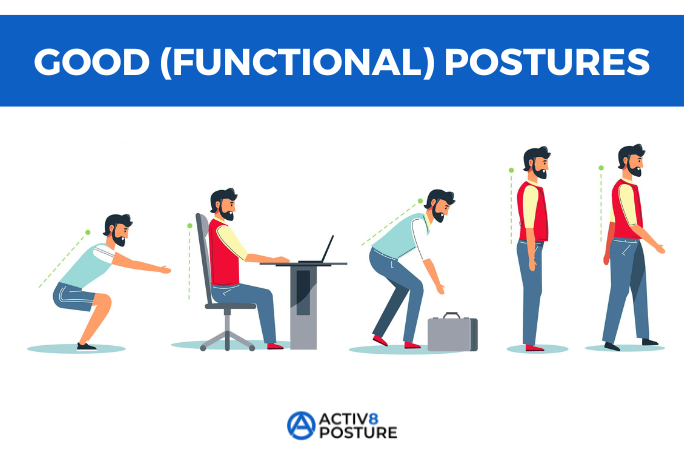
In contrast, good posture is often described as optimal body alignment. That phrase needs one large caveat: when researchers measured eight postural angles in 99 healthy people, they found no single optimal arrangement existed at all. More on that below. This involves standing, sitting, and moving in ways that reduce strain on your supporting muscles and ligaments. With our approach at Activ8 Posture, this doesn’t mean you should necessarily have to obsess over keeping your shoulders back and your back straight consciously throughout the day. Like they say with water and staying hydrated, “If you’re thirsty, you’re probably already dehydrated.” Similarly, by giving your body the proper stimulus through postural exercises, you’ll be ensuring your body maintains alignment and integrity and that your weight is distributed evenly across your feet when standing – without having to think about it.
Top 10 poor postures frequently observed:
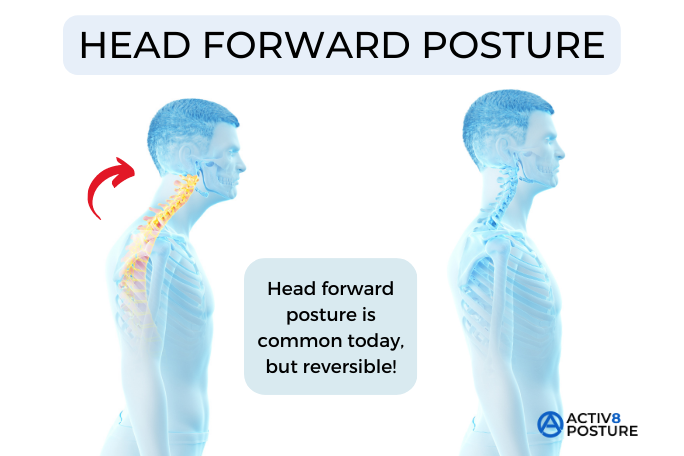
- Text Neck: This posture is common among those frequently using mobile devices. It involves bending the neck to look down at the screen, leading to neck and shoulder pain.
- Forward Head: Often seen in office workers with poor ergonomics, this involves leaning the head forward, extending beyond its balanced, neutral position.
- Rounded Shoulders: This posture features shoulders that are slumped forward, often resulting from long hours spent at a computer.
- Hunched Back: Also known as kyphosis, an exaggerated back rounding characterizes this posture.
- Anterior Pelvic Tilt: This posture is characterized by an exaggerated forward tilt of the hips. It often results from weak abdominal muscles and tight hip flexors, causing lower back discomfort.
- Arched Back: Also known as lordosis, it’s an excessive inward curve of the lower back, often paired with a protruding abdomen.
- Leaning on One Leg: Frequently shifting body weight to one leg, whether from a past injury or a dominant side, leads to muscle imbalances and spine misalignment.
- Uneven Shoulders: This posture, usually caused by muscle imbalances or carrying heavy bags on one shoulder, is marked by one shoulder being higher than the other.
- Uneven Hips: A hip-hike or disparity, usually resulting from an imbalance in the strength or flexibility of the muscles around the hips and lower back, often causes problems up and down the body.
- Flat Back: A flat back posture is characterized by a lack of natural curves in the spine. This often leads to pain and discomfort as it can strain your muscles and ligaments, making it difficult to maintain an upright posture.
By recognizing and correcting these postures, we can begin the journey toward improved alignment and overall health.
Is Bad Posture Permanent?
While the difference between good and bad posture may seem stark, the encouraging news is that poor posture is not a life sentence. Just as your cardiovascular health can improve with regular exercise and a healthy diet, your posture can significantly improve with the proper stimulus.
Physical activities, especially those that build strength and widen the range you can comfortably control, have real and measurable effects. Regular stretching and mindful awareness (until it’s habitual) of how you sit, stand, and move throughout the day can also bring about substantial improvements. With a consistent, targeted effort, transforming your posture is realistic. “Poor to excellent” is the wrong scale, though, because no single correct posture has ever been defined to aim at — what improves is measurable in other ways, set out below. Just like maintaining cardiovascular health, enhancing your posture is an ongoing journey, but it’s well worth embarking on for your overall health and well-being.
What Changes With Age, and What Does Not
The worry underneath this question is almost always about age, so it deserves an answer built from evidence rather than encouragement.
A 2020 systematic review and meta-analysis in Sports Medicine pooled 22 randomized controlled trials of resistance training in people aged 75 and over. Muscle strength improved, with a pooled effect size of 0.97 (95% CI 0.50 to 1.44). In the subgroup aged 80 and over, the effect size was 1.28 (0.28 to 2.29) — still statistically significant. That interval is wide, reflecting a small number of trials, so it does not establish that older people respond better. What it does rule out is the idea that they stop responding.
Not everything moved. Handgrip strength (0.26, −0.02 to 0.54) and muscle-fiber size did not reach significance, and whole-muscle size changed only modestly (0.30, 0.10 to 0.50). Strength and function responded more than tissue size did — which is worth knowing, because it means the gains show up in what you can do rather than in how you look.
The landmark single study is more vivid. In 1990, researchers put ten frail nursing-home residents — mean age 90, the oldest 96 — through eight weeks of high-intensity strength training. Among the nine who completed it, strength rose 174%, mid-thigh muscle area grew 9%, and tandem gait speed improved 48%. The authors concluded that resistance training “leads to significant gains in muscle strength, size, and functional mobility among frail residents of nursing homes up to 96 years of age.”
Nine people is a very small study, and it tested weight training in a nursing home, not posture therapy in a clinic. So read it as evidence about the mechanism — whether muscle and connective tissue can still adapt late in life — rather than as evidence about any particular service. The mechanism is intact at 90. That is the part people doubt, and it is the part that is settled.
What Does Change, and by How Much
If no single posture has been established as the correct one to aim at, the fair question becomes what actually does respond. The largest body of evidence on that is a 2021 Cochrane review of exercise for chronic low back pain, pooling 249 trials and 24,486 participants. Against no treatment, usual care or placebo, exercise reduced pain by 15.2 points on a 100-point scale (95% CI −18.3 to −12.2) at moderate certainty — a clinically important difference. Functional limitation improved by 6.8 points, a real improvement.
Now set that beside what happens to the curve itself, measured in a separate meta-analysis of exercise and spinal curvature:
| What was measured | What happened |
|---|---|
| Pain | Down 15.2 points — moves, and by a clinically important amount |
| Physical function | Down 6.8 points — a real improvement |
| The lumbar curve angle | Not the number that tracks progress (no significant change, p = 0.401), which is why progress is measured in pain and function |
Read that table as an instruction about what to measure. The thing that responds is not the thing people are usually told to fix.
The caveats belong here too, because they are what make the rest believable. Exercise showed no clear advantage over manual therapy; it did beat education alone and electrotherapy. The strong claim is exercise against doing nothing. And a network meta-analysis of 217 trials and 20,969 participants ranked exercise types against each other — Pilates came out highest, at 18.7 points — but its actual conclusion was about something else: people “should be encouraged to perform the exercise that they enjoy to promote adherence.”
That is the most useful sentence in this literature. The best-ranked exercise and the one you will still be doing in a year are different questions, and the researchers who assembled the largest comparison ever made came down on the second. In practice what changes is your range of motion, your strength, how well the right muscles coordinate and fire, how quickly a new movement pattern stops needing conscious attention, and how much load you tolerate before symptoms appear. Those are the things worth tracking — and the things a program is worth building around.
What Does Bad Posture Cause?
While aesthetic concerns are important, bad posture presents serious issues that can significantly impact your physical and mental well-being. A few direct consequences of bad posture:
Physiological Impacts
Bad posture often leads to numerous musculoskeletal problems, such as:
- Chronic back pain: A constant slouch or hunch can put excessive pressure on your back muscles and ligaments, resulting in persistent discomfort.
- Neck pain and headaches: The ‘forward head’ posture commonly seen in desk workers can cause tension in the neck, potentially leading to frequent headaches.
- Shoulder pain:Slouching can place undue stress on your shoulder blades and upper back, often manifesting as shoulder pain.
- Reduced mobility: Over time, poor posture can cause changes in your spine’s natural curves, limiting your range of motion and flexibility.
- Impaired lung function:Slumped sitting can reduce how fully your lungs expand, which can make deep breaths feel harder.
Psychological Impacts
The effects of bad posture aren’t limited to the physical. It can also affect your psychological well-being:
- Lower self-esteem: A slouched posture is often perceived as a sign of low confidence and can influence your self-image negatively.
- Increased stress levels: Chronic pain and discomfort resulting from poor posture can contribute to heightened stress and anxiety levels.
As these short lists only represent the tip of the iceberg, the long-term effects of bad posture extend far beyond temporary discomfort. Over time, poor posture can lead to lasting changes in your body’s physiology, such as alterations in the spine’s natural curves and an increased risk of disc damage or degenerative joint disease. It’s also associated with a higher likelihood of developing osteoarthritis.
By understanding these impacts, we appreciate the importance of addressing postural issues now versus waiting for things to worsen.
Why Do I Have Bad Posture?
Understanding the root of this problem is an important part of the solution. In today’s modern society, poor posture is widespread, and we all share the struggle to adapt to our fast-evolving environments. Reports show that an estimated 80% of the population will experience back pain at some point in their lives. That figure describes how common back pain is — not what causes it. The distinction matters more than it sounds, and the evidence below is blunt about how little any single postural measurement predicts.
There’s a good chance you are among the many whose posture has been influenced by daily routines and habits. Sitting at a desk for long periods, hunching over laptops, and continually looking down at our smartphones – dubbed ‘text neck’ – all lead to postural issues. These behaviors can often lead us to slouch, which can strain the ligaments and muscles that maintain the spine’s natural curves, eventually leading to bad posture.
However, our lifestyle isn’t the only contributing factor. Commonly, people having an accident or injury that was never properly addressed continue to feel the effect of their inability to maintain correct posture. Others may have genetic predispositions or conditions that result in poor posture.
Our Body and Mind Work Together
Let’s also acknowledge the psychological aspect. Our mental and emotional states can influence our posture without us even realizing it. Stress, for instance, often makes us tense up our shoulders and neck, contributing to poor posture over time.
Remember that bad posture isn’t something to be ashamed of, as it’s a common issue in today’s society. The encouraging news is each of us has the power to make positive changes. Recognizing the cause of poor posture is the first step towards correction and a healthier lifestyle.
Bad posture is increasingly common today due to our sedentary lifestyles. Factors like long hours of sitting, consistent use of smartphones (text neck), and even psychological issues can contribute to poor posture. Some people might also have poor posture due to genetic factors or injuries.
How Long Does It Take to Fix Bad Posture?
Two things can be said with numbers behind them. First, the trials that measured real change mostly ran eight to twelve weeks: the nonagenarian strength study was eight weeks, the hip-tendon trial measured improvement at eight weeks and still had it at one year, and the ankle mobility trial ran eight weeks at three sessions a week. Second, the largest study on timing found that people who started sooner got more out of the same number of visits. And you have dedicated posture therapists like us here to guide you every step of the way.
Improving posture is a process in that progressive corrective exercises will impact your body significantly. Along with this, lifestyle modifications and adjusting how we perceive our bodies also help. Activ8 Posture’s therapeutic approach works synergistically with your body, promoting a healthier alignment from the inside out. This inside-out approach paves the way for a more sustainable solution rather than just treating symptoms.
Starting Sooner Beats Starting Later
This is the one figure on this page that argues against waiting, and it comes from the largest relevant dataset available: 11,941 people treated for low back pain in outpatient physical therapy clinics across eleven states. Researchers grouped them by how long they had had symptoms before starting care, then measured the change in a 0–100 functional status score.
| How long symptoms had lasted | Function gained (0–100) | Visits |
|---|---|---|
| Under 14 days | 29.32 | 13.66 |
| 15 to 90 days | 21.66 | 14.05 |
| More than 90 days | 15.92 | 14.63 |
Look at the visit counts before the gains. All three groups attended an almost identical number of appointments, and the improvement differed by nearly twofold. Waiting did not close the door — people who had been in pain for more than three months still gained about sixteen points — but it did appear to cost roughly half of what was available.
Two caveats, and the second one is interesting. This was a retrospective study of clinical records rather than a randomized trial, so people who sought care quickly may differ from those who waited in ways nobody measured. And acute back pain frequently improves on its own, which means some of that 29-point gain in the first group is natural recovery rather than treatment. That cuts in an unexpected direction: the 16 points in the long-duration group is the figure most fairly credited to the care itself, because pain lasting more than three months has already shown it is not resolving unaided.
Your Body United
Fixing bad posture is not simply about standing straighter or sitting without slouching – it’s about understanding and maintaining the body’s desire for balance. It’s also more than just your core muscles, glutes, and hamstrings. All of the muscles interact with your bones, joints, nervous system, fascia, and so on to play a significant role in aligning your body. That’s why we work on straightening and then strengthening the critical areas that support you from the feet, ankles, knees, hips, pelvis, lower back and up the spine, shoulders, neck, and head.
We realize some may be sensitive to the term “bad posture” so it’s helpful to use the term “problematic posture.” It’s a more accurate description of the consequences of long-term poor postural habits.
Here are some common problems associated with problematic posture:
- Chronic neck, shoulder, and back pain
- Increased risk of falls and injuries
- Decreased flexibility and mobility
And common pains and symptoms include:
- Tension headaches
- Difficulty breathing
- Fatigue
- Sciatica
Recognizing the importance of correcting problematic posture is the first step in creating lasting change. Activ8 Posture’s holistic approach ensures that this change isn’t just about temporary fixes but establishing a healthier lifestyle for years to come.
Activ8 Posture’s Approach: Gentle Posture Exercises for a Healthier You
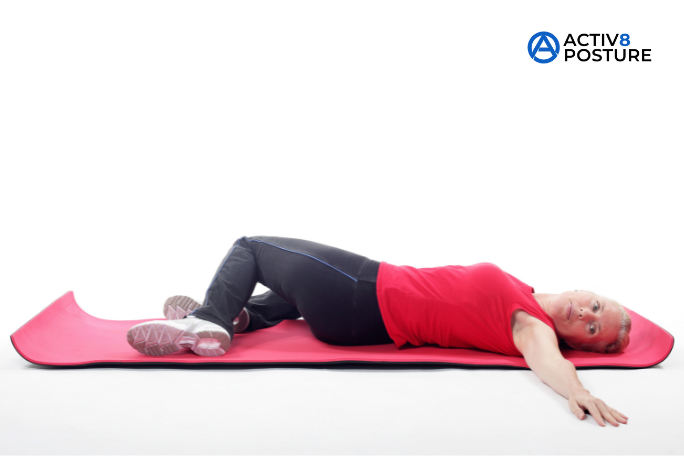
A crucial part of improving posture is the integration of targeted postural exercises into your daily regimen. But this doesn’t mean intense gym sessions or strenuous workouts. Rather, we’re talking about the right-fit exercises that promote better posture that you can easily incorporate into your routine.
At Activ8 Posture, we understand that each person’s journey to better posture is unique. Our posture therapy program is tailored to meet you where you are currently. We don’t believe in a protocol-based or one-size-fits-all approach but tailor a progression plan that adapts as your body does.
Take What the Body Gives and Work from There
Our postural exercises vary and include everything from gentle repositioning poses to full-body, multi-planar functional exercises. Sometimes, we must engage specific muscles to incorporate abdominal muscle strengthening, shoulder blade squeezes, and thoracic spine stretches. And while each of these exercises targets key areas of the body, we always want to elicit the whole body to work as a unit (using more kinetic chain activity). This holistic principle is essential in maintaining a healthy posture.
For instance, strengthening your abdominal muscles helps support your lower back, alleviating unnecessary pressure and promoting a healthier spinal alignment. And shoulder blade squeezes work to counteract the ‘hunched’ posture often resulting from extended desk or computer periods. Meanwhile, the thoracic spine stretches to focus on the mid-section of your spine, promoting flexibility and reducing the risk of back pain.
However, merely doing these exercises individually isn’t enough. It’s crucial to sequence and execute them correctly for your body and tie the changes in these specific areas to work with your whole body. The proper form and guidance are essential in ensuring these exercises are effective and safe. We guide you through every step, ensuring you’re comfortable and confident in independently performing these exercises to make your desired progress.
So, remember, you don’t have to navigate this journey alone. Activ8 Posture’s tailored approach and guided exercises assist you every step toward better posture.
Change Is Available at Any Age
Proactive Steps: Additional Tips for Improving Your Posture
While integrating specific exercises into your routine plays a pivotal role in bettering your posture, you can adopt a few simple yet impactful habits today. When practiced consistently, these habits will significantly affect your posture.
Following the principles of James Clear’s Atomic Habits, we recommend introducing these new habits gradually and embedding them in your current routine.
Here are some actionable tips you can employ to kickstart your journey toward better posture:
- Practice Standing Tall: One of the ways to improve your posture is by practicing standing tall. To do this, stand with your back against a wall. This helps you sense and adjust your posture, promoting a more upright stance. Use the wall as a guide to align your head, shoulders, and hips, ensuring they touch the wall. Deep breath through your diaphragm to help relax your upper body.
- Adopt Sitting Tall: When seated, make a conscious effort to sit forward in your chair. Begin by rolling your hips forward, extending your lower back. This sitting posture allows your upper body to relax naturally while maintaining a vertical alignment. Your back will be straight, and your shoulders relaxed, reducing the strain on your spinal structures. Again, deep breathing helps calm overactive shoulder and neck muscles. (You don’t have to stay seated like this all the time, but it’s a great way to wake up your hip and lumbar spine muscles.)
- Keep Your Feet Straight: A commonly overlooked aspect of good posture is foot alignment. Ensure your feet are pointing straight ahead when standing or walking. You might observe that your feet tend to point outwards during the day. And while they should line up naturally, try consciously correcting them to point straight, especially when standing for extended periods. This position aids in distributing your body weight evenly across your feet, reducing undue strain on your ankles and knees.
- Elevate Your Screen: Finally, when using digital devices, make sure your screen is at eye level. This tip helps prevent you from straining your neck and hunching your shoulders, common postural problems associated with prolonged screen time. (See our Ergonomics Checklist for more tips).
In addition to these habits, we at Activ8 Posture emphasize the importance of regular check-ups with a postural therapist.
These check-ups are crucial for several reasons:
- Personalized Guidance: Each individual has unique postural needs. Regular check-ups allow for personalized advice and adjustments to your exercise routine and habits.
- Progress Tracking: Therapists can monitor your progress and modify your plan as necessary, ensuring effective and efficient improvements in your posture.
- Accountability: Regular appointments create a commitment, boosting your motivation and consistency in maintaining good posture habits and exercises.
Remember, the journey to better posture is not a sprint but a marathon. When consistently practiced over time, these habits can lead to noticeable improvements in your posture and, ultimately, a healthier, happier you.
The Activ8 Posture Difference: Tailored Solutions for Improved Posture
At Activ8 Posture, we’re rooted in the understanding that each individual’s posture is as unique as they are. This is why our approach is so distinctive. We offer individualized posture therapy, developed after a detailed evaluation of your specific needs, to help you tackle years of poor posture.
We are committed to helping you transform your posture regardless of where you are. Our conveniently located clinics in Los Angeles and Boston are designed to provide you with personalized, hands-on guidance from our team of experts. But if you’re unable to make it in person, we’ve got you covered! We also offer virtual sessions, ensuring that geography doesn’t hinder your journey toward improved posture.
Our individualized posture therapy can provide numerous benefits, including:
- Improved Mobility: As we work with you to correct your posture, you may experience enhanced flexibility and range of motion.
- Reduced Pain: Improved posture often leads to a reduction in common pain points, such as neck, shoulder, or back pain.
- Increased Energy: With better alignment, your body works more efficiently, potentially increasing energy levels.
- Boosted Confidence: Standing tall and straight can positively impact self-confidence and overall body image.
- Enhanced Overall Health: Many people find it easier to take a full breath and feel more comfortable through the day when they sit and stand taller.
Our team at Activ8 Posture is here to support you every step of the way on your journey toward better posture. Regardless of how long you’ve been dealing with postural issues, we’re confident that we can guide you toward a healthier, more balanced body.
Key Takeaways
Yes, posture can improve even after many years. Strength, mobility and movement habits are trainable at any age.
Change is gradual and comes from consistent practice over months. Many people find that pain eases and movement feels easier along the way, and keeping up the habits is what makes the change last.
FREE!
Frequently Asked Questions
Can bad posture be fixed?
Yes, and there are numbers behind it. Pooled across 249 trials and 24,486 participants, exercise reduced low back pain by 15.2 points on a 100-point scale compared with no treatment — a clinically important difference. Age is not the barrier either: 22 trials in people aged 75 and over found strength still improved significantly, including in those past 80. What varies is the pace, not whether it works. Note that what responds is your comfort, strength and movement options rather than a specific measured angle — which is the subject of the table further up this page.
What are the most common types of poor posture?
Many of us fall into several common types of poor posture without realizing. These include Text Neck, Forward Head, Rounded Shoulders, Hunched Mid-Back or Upper Back, Anterior Pelvic Tilt, Arched Low Back, Leaning on One Leg, Uneven Shoulders, Flat Back, and Uneven Hips. Each type carries its own set of challenges and requires specific corrective strategies.
How do you fix long-term poor posture?
Long-term poor posture can be improved through targeted exercises, lifestyle changes, and professional guidance. Activ8’s individualized posture therapy is designed to meet you where you are and progress you as your body allows, using gentle exercises to guide your progress.
Can bad posture be cured?
“Cured” is the wrong word, and the distinction is worth making. A cure implies a condition that ends. Posture is a set of habits held by living tissue, so it responds the way fitness responds: it improves with the right stimulus and it drifts back without one. That is not a disappointing answer — it is the same deal as cardiovascular health, and nobody considers that a failure. Expect meaningful improvement in weeks to months, and expect to keep some version of the work going, in whatever form you will actually stick with.
What happens if I have bad posture for a long time?
Maintaining poor posture over time can lead to various physiological and psychological impacts, from chronic pain and reduced mobility to lower self-esteem and higher stress levels. It will not, on its own, reshape the bones of your spine. Changes built into the vertebrae come from specific causes — compression fractures or Scheuermann’s disease — rather than from years of slouching, and a curve that softens when you lie flat or stand tall is a postural one. Neck hump and hunchback explain how to tell the difference, and when a new or growing curve after 50 is worth a medical conversation rather than an exercise plan.
Will working with a chiropractor or physical therapist help fix my posture faster?
Integrating various professional healthcare services can potentially speed up your posture correction process as long as these practitioners embrace a collaborative approach. At Activ8 Posture, we believe in the power of a team working together for your well-being. We are dedicated to working with your physical therapist, chiropractor, or massage therapist, provided they appreciate the value of a united team dedicated to your progress. Remember, it’s your health journey, and we all are here to support you.
Should I still work out if I have bad posture?
We recognize that each individual’s situation is unique, and there’s no one-size-fits-all answer. In most cases, we encourage regular exercise as it is beneficial for overall health and can even help fix your posture. However, ensuring that your workout regimen isn’t inadvertently exacerbating postural imbalances or reinforcing dysfunctional movement patterns is vital. We highly recommend incorporating posture-specific exercises into your workout routine and maintaining proper form during all activities to prevent further strain or injury. The aim is to support and enhance your posture improvement journey, not hinder it. At Activ8 Posture, we can guide you in designing an exercise plan that aligns with your posture correction goals while keeping you active and healthy.
Is it true that fixing bad posture hurts?
When undertaken correctly, posture correction should not be painful. As you begin your journey towards improved posture, you may experience new sensations in your body, such as muscle soreness. This is a normal part of the process as we awaken and engage muscles that might not have been used optimally in a while. It’s important to remember that this discomfort typically eases as your body adjusts to healthier postural habits. At Activ8 Posture, we see pain as an important signal. If you experience any during your posture correction process, we take it as a cue to listen to your body and make necessary adjustments to your regimen. The aim is not to ‘power through’ pain but to foster a sustainable, gradual improvement that respects your body’s unique rhythm and needs.
Sources
- Grgic J, Garofolini A, Orazem J, Sabol F, Schoenfeld BJ, Pedisic Z. Effects of resistance training on muscle size and strength in very elderly adults: a systematic review and meta-analysis of randomized controlled trials. Sports Medicine 2020;50(11):1983–1999. 22 randomized controlled trials, participants aged 75 and over.
- Fiatarone MA, et al. High-intensity strength training in nonagenarians: effects on skeletal muscle. JAMA, 1990. Ten frail nursing-home residents, mean age 90; nine completed.
- Walston Z, McLester C, McLester J. Effect of low back pain chronicity on patient outcomes treated in outpatient physical therapy: a retrospective observational study. Archives of Physical Medicine and Rehabilitation 2020;101(5):861–869. 11,941 patients. Retrospective, not randomized.
- Hayden JA, Ellis J, Ogilvie R, Malmivaara A, van Tulder MW. Exercise therapy for chronic low back pain. Cochrane Database of Systematic Reviews, 2021. 249 trials, 24,486 participants.
- Hayden JA, Ellis J, Ogilvie R, et al. Some types of exercise are more effective than others in people with chronic low back pain: a network meta-analysis. Journal of Physiotherapy 2021;67(4):252–262. 217 trials, 20,969 participants.
- Claeys K, Brumagne S, Deklerck J, Vanderhaeghen J, Dankaerts W. Sagittal evaluation of usual standing and sitting spinal posture. Journal of Bodywork and Movement Therapies, 2016. 99 healthy people.
- González-Gálvez N, Gea-García GM, Marcos-Pardo PJ. Effects of exercise programs on kyphosis and lordosis angle: A systematic review and meta-analysis. PLOS ONE, 2019.
Where to go next
- Browse Posture & Alignment for more on this topic.
- Read how we correct posture.
- Not sure where to start? A free 30-minute consultation and posture assessment, at one of our clinics or virtually, is the best first step.


