

Serratus Anterior: Anatomy, Function, and Scapular Winging
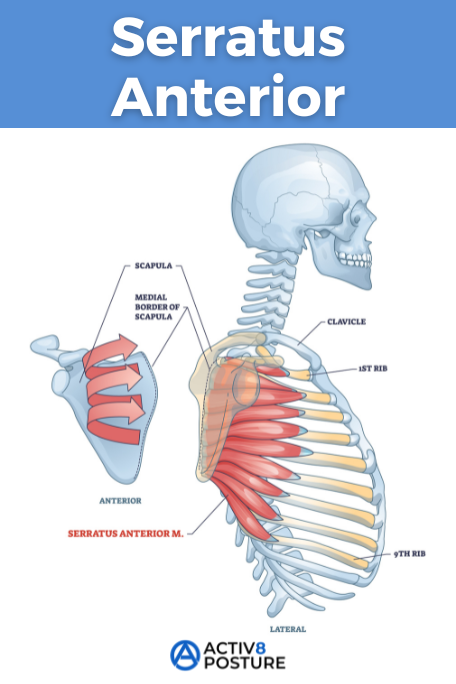
Quick answer: The serratus anterior originates on the outer surfaces of the first eight or nine ribs along the side of the chest and inserts along the superior angle, medial border, and inferior angle of the scapula. It is supplied by the long thoracic nerve, from spinal levels C5, C6, and C7. Its job is to hold the shoulder blade flat against the rib cage and to pull it forward and rotate it upward, which is what allows you to reach overhead. When the long thoracic nerve is injured, the muscle can no longer hold the scapula down and the inner edge lifts away from the back — the medial scapular winging that makes this muscle famous.
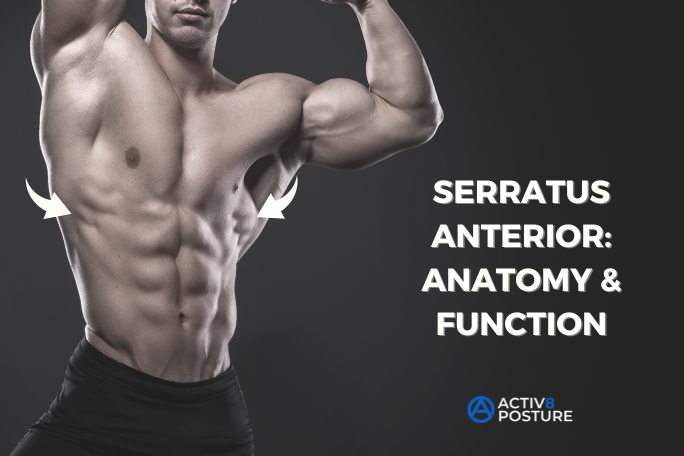
Serratus Anterior Anatomy at a Glance
| Detail | |
|---|---|
| Origin | Superolateral surfaces of ribs 1–8 (ribs 1–9 in some people), on the lateral wall of the thorax |
| Insertion | Costal (deep) surface of the scapula along the superior angle, medial border, and inferior angle |
| Innervation | Long thoracic nerve (C5, C6, C7). The upper portion often has an additional independent branch. |
| Primary actions | Scapular protraction; upward rotation of the scapula; holds the scapula against the thoracic wall |
| Works with | Upper and lower trapezius, to sustain upward rotation during overhead lifting |
| Blood supply | Lateral thoracic artery, with contributions from the thoracodorsal and intercostal arteries |
| Signature failure | Medial scapular winging — the scapula translates superiorly and the inferior angle rotates toward the spine |
Those attachment details are the reason this muscle behaves differently from most. It is the only muscle that originates on the ribs and inserts on the scapula, so it is the structural link between the shoulder blade and the chest wall. Anatomy sources describe it as holding the scapula against the thorax (StatPearls), and that single function is what everything else depends on.
What the Serratus Anterior Actually Does When You Move
Raise your arm overhead and the shoulder blade has to travel. It rotates upward, tilts backward, and slides around the curve of the rib cage. That coordinated movement between scapula and arm is called scapulohumeral rhythm, and roughly a third of the total motion comes from the shoulder blade rather than the ball-and-socket joint itself.
The serratus anterior drives the scapular share of that. It works with the upper and lower fibers of the trapezius to sustain upward rotation, which is what clears space for the arm to keep rising. Without it, the arm runs out of room partway up.
It also does something less obvious: because it attaches to eight or nine ribs, it pulls on the rib cage as well as on the scapula. Where your rib cage sits therefore changes the length the muscle has to work at. This is the part most anatomy pages leave out, and it is the reason a shoulder blade problem is often not only a shoulder problem — see rib flare for the version of this that shows up at the front.
When the Shoulder Blade Sticks Out: Three Different Problems That Look Alike
A shoulder blade whose inner edge lifts off the back — a winged scapula — is the most searched-for sign of serratus trouble, and the most frequently misattributed. Winging is not one condition. It has at least three distinct origins, and they call for completely different responses.
| Medial winging | Lateral winging | Secondary winging | |
|---|---|---|---|
| What fails | Serratus anterior | Trapezius, or the rhomboids | Nothing in the scapular muscles — the shoulder joint itself |
| Nerve involved | Long thoracic nerve | Spinal accessory nerve (trapezius); dorsal scapular nerve (rhomboids) | None |
| How the scapula moves | Translates upward; the lower tip rotates toward the spine | Translates downward; the lower tip rotates away from the spine | Varies — follows whatever the joint is doing |
| What provokes it | Pushing forward, as in a push-up or a wall press | Resisted shrugging, or pushing the elbows back with hands on hips | Reaching, often with pain before the winging appears |
| Common causes | Stretch injury from overhead work, trauma, viral illness, surgery near the chest wall or armpit | Neck lymph node biopsy, surgery or trauma to the side of the neck | Rotator cuff tear, shoulder instability, frozen shoulder, subacromial bursitis |
| Who should see it | Physician or neurologist first | Physician or neurologist first | Shoulder specialist or physical therapist |
The classification and the examination maneuvers above come from the StatPearls review of scapular winging. The practical takeaway is that the direction the lower tip of the shoulder blade rotates tells you which muscle is involved — and whether a nerve is the problem at all.

Something You Can Check Right Now
Stand facing a wall, an arm’s length away, and place both palms flat on it at about chest height. Press into the wall as if trying to push it away, and have someone look at your back — or film it on your phone. Both shoulder blades should stay flat. If one lifts away as you press, you have found the thing worth describing to a clinician.
This is an observation, not a diagnosis, and it is not a treatment. Note which side, whether it appears straight away or only after several presses, and whether anything hurts. Those three details are genuinely useful to whoever examines you, because immediate weakness and fatigue-dependent weakness suggest different things.
When to See a Doctor First, Not a Posture Program
Some winging is a nerve injury. Posture work is not the answer to a nerve injury, and starting there wastes time that matters. Get a medical assessment before anything else if:
- The winging appeared suddenly, or after a fall, collision, or heavy overhead effort.
- It followed surgery or a biopsy near the chest wall, armpit, or side of the neck, or a period under anesthesia.
- It followed a viral illness or came with severe shoulder or neck pain that preceded the weakness.
- You have numbness, pins and needles, or weakness elsewhere in the arm.
- The arm has become genuinely weak overhead rather than just awkward or tired.
- There is visible wasting of muscle around the shoulder blade or collarbone.
What a clinician can tell you that a website cannot: whether the nerve is involved, and if so how badly. That changes the entire timeline. For a nerve that is bruised rather than torn — which is the most common pattern — published guidance describes functional recovery anywhere from about one month to two years, and recommends observing nerve recovery with non-surgical treatment for one to two years before considering surgery. Roughly a quarter of serratus anterior palsies persist despite that conservative care (StatPearls).
That is a hard set of numbers, and it is better to have them early than to spend eighteen months assuming a stubborn shoulder blade is a discipline problem.
The Reassuring Part: An Unusual-Looking Shoulder Blade Is Often Fine
Scapular dyskinesis is the clinical term for a shoulder blade that moves abnormally. It is easy to find, it photographs well, and it is widely treated as a fault to be corrected. The evidence is considerably less certain than that.
A 2023 systematic review pooling 34 studies and 2,365 people found scapular dyskinesis in about 60% of people with symptoms — and in about 48% of people without any symptoms at all, rising to 59% in asymptomatic members of the general population. Across individual studies the asymptomatic rate ranged from 0% to 92%, which tells you as much about the inconsistency of the measurement as about the shoulders being measured. The authors concluded it may be a relatively normal finding in nearly half the asymptomatic population, and raised the question of whether it represents normal movement variability rather than pathology (Salamh et al., IJSPT 2023).
It also turns out to be a poor predictor. A meta-analysis of seven prospective studies following 923 athletes, published in the American Journal of Sports Medicine, found a pooled risk ratio of 1.07 (95% CI 0.85–1.34) — no significant association between scapular dyskinesis and later shoulder injury. The authors concluded the current evidence does not support using an isolated dyskinesis test to identify athletes at risk (Hogan et al., 2021). An earlier review had reported a 43% increase in risk, so the literature genuinely disagrees with itself; the larger and more recent prospective pooling is the less alarming one.
And yet working the scapular muscles does help people who already hurt. A systematic review of seven trials in subacromial shoulder pain found scapular stabilization programs reduced pain and disability and improved strength and shoulder function, though the trials were small, of moderate quality, and too varied to pool statistically (Journal of Exercise Rehabilitation).
Put together, that points to a clear plan: strengthening and coordinating the muscles around the shoulder blade is well worth doing when your shoulder hurts or feels weak, while a shoulder blade that looks a little unusual but doesn’t hurt usually needs no treatment. If your scapula wings slightly, nothing hurts, and you can do everything you want to do, you can leave it alone.
Anyone who tells you a protruding shoulder blade must be corrected, or that it will inevitably cause injury later, is going beyond what the evidence supports.
Why the Serratus Is Rarely the Whole Story
Because this muscle spans the ribs and the shoulder blade, it sits downstream of things that have nothing to do with the shoulder. Change where the rib cage sits and you change the muscle’s working length before it contracts at all. Common patterns that interact with it:
| What else is going on | How it reaches the serratus anterior |
|---|---|
| Rounded shoulders | The scapula sits forward and tipped, so the serratus is already shortened and has less range left to pull through. |
| Increased thoracic curve | A more rounded upper back changes the surface the scapula has to glide across, altering upward rotation. |
| Rib flare | Rib position changes the muscle’s origin, so the same effort produces a different pull. |
| Forward head posture | Rarely isolated; usually travels with the shoulder and rib cage changes above it. |
| Upper crossed pattern | The described combination of tight chest and neck muscles with weak deep neck flexors and scapular stabilizers. |
| Side-to-side asymmetry | Most people are asymmetrical, and one shoulder blade commonly sits differently from the other without any nerve involvement. |
This is why an assessment that only looks at the shoulder blade tends to produce exercises that do not hold. It is also why some people strengthen diligently for months and see the same picture in the mirror: the muscle was not the limiting factor. Related reading on the broader pattern: muscle imbalance and thoracic back pain.

Sleeping Position: What Helps
This comes up often enough to deserve a straight answer: there is no research on sleeping position for a winged scapula. No trial has tested it, and anyone presenting a specific position as the correct one is offering an opinion, not a finding.
What is reasonable to say is narrower. Sleep is about comfort and staying asleep, not about correcting a shoulder blade — you cannot train a muscle while unconscious. If side-lying on the affected shoulder is uncomfortable, most people find it easier to lie on the other side with a pillow supporting the top arm so it is not dangling forward across the body, or on their back with a thin pillow. If a position hurts, that is reason enough to change it. If nothing is comfortable, that is worth mentioning to a clinician, because persistent night pain in a shoulder is its own signal.
Frequently Asked Questions
What are the origin and insertion of the serratus anterior?
It originates on the superolateral surfaces of ribs 1–8 — ribs 1–9 in some people — along the lateral wall of the chest, and inserts on the deep surface of the scapula at the superior angle, the medial border, and the inferior angle.
What nerve innervates the serratus anterior?
The long thoracic nerve, carrying fibers from spinal levels C5, C6, and C7. The upper part of the muscle frequently receives an additional independent branch, which is one reason weakness is sometimes partial rather than complete.
What is the main action of the serratus anterior?
Two things that work together: it protracts the scapula, pulling it forward around the rib cage, and it rotates the scapula upward. Underneath both, it holds the scapula flat against the thoracic wall. The upward rotation is shared with the upper and lower trapezius and is what allows the arm to rise fully overhead.
Why is my scapula winging?
Three broad possibilities, and they are distinguishable. If the serratus anterior is weak, usually from long thoracic nerve injury, the lower tip of the shoulder blade rotates toward the spine and the winging shows up when you push forward. If the trapezius or rhomboids are involved, the lower tip rotates away from the spine instead. And if the shoulder joint itself has a problem — a rotator cuff tear, instability, a frozen shoulder — the scapula can move abnormally with no scapular muscle fault at all. Sudden onset, onset after surgery, or winging with arm numbness or weakness all warrant medical assessment first.
Can a winged scapula be fixed?
It depends on the cause. Where a nerve has been stretched or bruised rather than severed, published guidance describes functional recovery over about one month to two years, with one to two years of non-surgical management recommended before surgery is considered; around a quarter of serratus anterior palsies persist despite that. Where no nerve injury is involved, the appearance may change only a little, but pain and function often improve, and those are the outcomes that matter most.
How long does serratus anterior palsy take to recover?
Most neuropraxic injuries — where the nerve is bruised rather than torn — recover function somewhere between about one month and two years. That is a wide range because nerve recovery is slow and difficult to predict. Standard practice is to observe recovery with conservative treatment for one to two years before considering surgical options.
What is the best sleeping position for a winged scapula?
There is no research on this, so no position can be called best. Sleep will not correct a shoulder blade either way. Choose whatever is comfortable: many people find lying on the unaffected side with a pillow supporting the top arm works, or lying on the back with a thin pillow. Persistent pain at night in a shoulder is worth reporting to a clinician.
Is the serratus anterior really called the boxer’s muscle?
Yes, informally. The nickname comes from its role in driving the shoulder blade forward during a punch, which is scapular protraction. It is a useful mental image, though the muscle’s more important everyday job is simply keeping the shoulder blade flat against the ribs.
Where to Start
If you came here for the anatomy, you have it and you owe us nothing. If you came here because one shoulder blade looks or feels wrong, here is how we would think about it.
- If anything on the red-flag list above applies — see a physician first. We would tell you the same thing if you called us, and we would decline to start a program until a nerve injury has been ruled out.
- If it is painless and limits nothing — leave it alone. Roughly half of people with no symptoms at all have an abnormally moving shoulder blade.
- If your shoulder hurts, reaching overhead is awkward, or you have been doing scapular exercises for months with nothing changing — that last pattern in particular is worth a look at the rib cage and thoracic spine rather than more of the same exercise.
That third case is where posture therapy is a reasonable fit. We assess how the whole chain moves — ribs, thoracic spine, shoulder blade, neck — rather than treating the shoulder blade as an isolated unit, and then build a progressive program from what the assessment actually shows. Our posture assessment walks through what we look at, so you can judge whether it addresses your situation before speaking to anyone.
If an assessment suggests a nerve problem or a structural shoulder problem, we’ll point you to the right specialist. If you want to talk it through, a free consultation is a conversation, not a commitment.

Sources
- Anatomy, Thorax, Serratus Anterior Muscle — StatPearls, NCBI Bookshelf. Origin, insertion, innervation, actions, and clinical significance.
- Winging of the Scapula — StatPearls, NCBI Bookshelf. Classification of medial and lateral winging, examination maneuvers, causes, prognosis, and management.
- Salamh et al. — Is it Time to Normalize Scapular Dyskinesis? International Journal of Sports Physical Therapy, 2023. Systematic review of 34 studies and 2,365 people comparing incidence in symptomatic and asymptomatic groups.
- Hogan et al. — Scapular Dyskinesis Is Not an Isolated Risk Factor for Shoulder Injury in Athletes American Journal of Sports Medicine, 2021. Meta-analysis of seven prospective studies, 923 athletes.
- Effect of scapular stabilization exercise program in patients with subacromial impingement syndrome: a systematic review — Journal of Exercise Rehabilitation. Seven trials, 228 participants.
This article is for general information and is not a substitute for individual medical assessment. If your shoulder blade changed suddenly, or you have arm weakness or numbness, see a physician.


